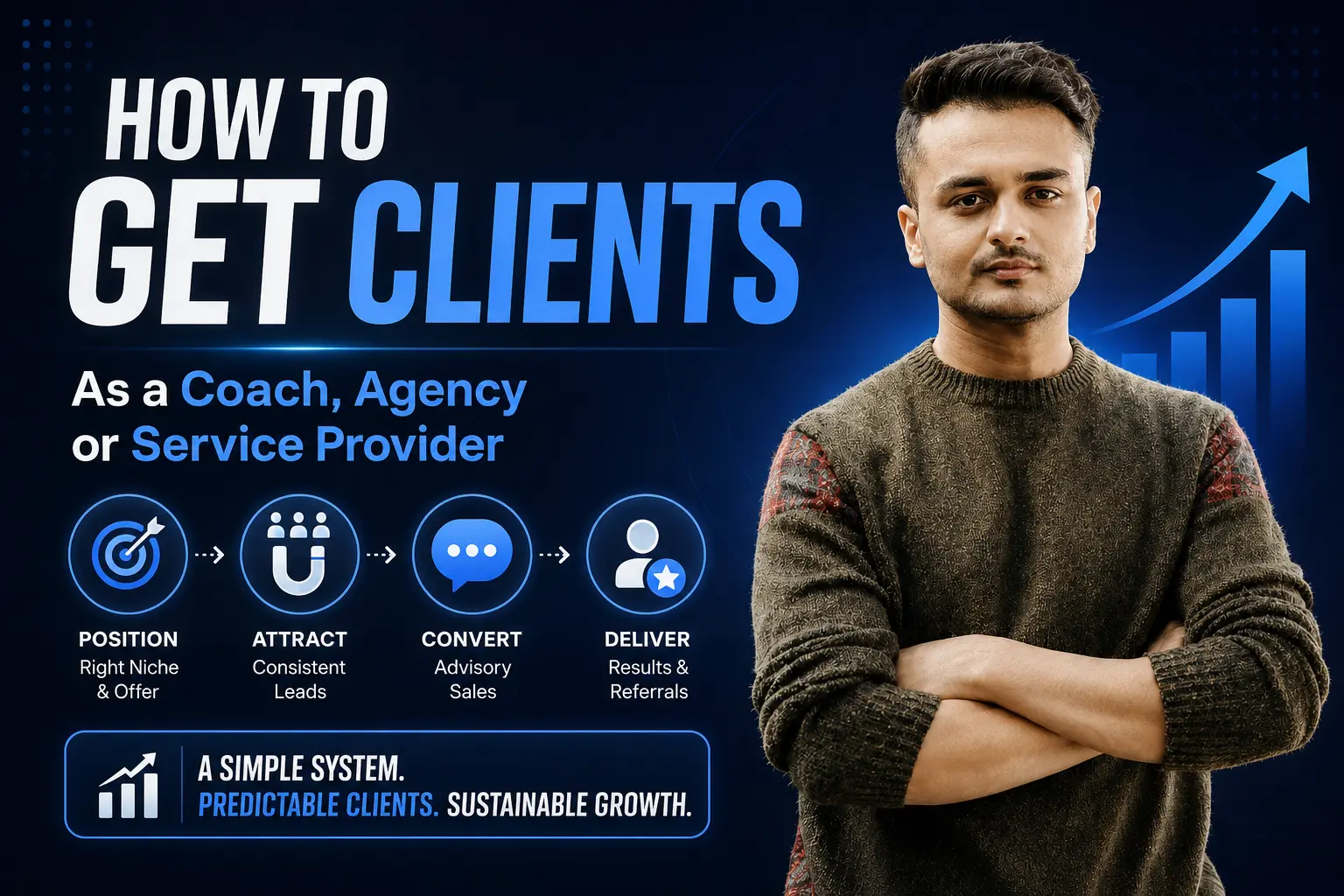
You get clients by fixing the acquisition problem in the right order: pick a specific niche, define the painful problem you solve, package it into a clear offer, price it properly, then run one acquisition channel consistently until it produces predictable leads. Most people skip straight to “channel” post more on LinkedIn, run more cold emails, join more Facebook groups without fixing niche, offer or pricing first. That’s why the tactic works for a week and then goes quiet.
This guide breaks the process into eight steps, in the order they actually need to happen, and then hands you off to a specific playbook depending on whether you’re a coach, consultant, agency or freelancer because the acquisition problem looks different for each.
Why Most “Get Clients” Advice Doesn’t Work
Search “how to get clients” and you’ll find the same recycled list everywhere: network, use social media, ask for referrals, cold email, build a portfolio. None of it is wrong. All of it is incomplete, because it treats client acquisition as a marketing problem when it’s usually a positioning problem.
- If your niche is too broad, every channel underperforms, you’re competing with everyone and relevant to no one.
- If your offer is a service (“I do SEO”) instead of an outcome (“I get SaaS companies to page 1 for their highest-intent keywords”), prospects can’t tell why you’re different from the next ten people in their inbox.
- If your pricing is low, you need a high volume of clients just to survive which forces you into low-quality acquisition channels like race-to-the-bottom marketplaces.
Fix those three first. Then the acquisition tactics below actually start converting.
The 8-Step Client Acquisition System
This is the same sequence niche, problem, offer, pricing, acquisition, sales, delivery, leverage that we use across every UAbility program, applied generically here so it works for any service-based business.
1. Choose One Specific Niche
“I help businesses grow” gets ignored. “I help D2C skincare brands cut customer acquisition cost through paid social” gets a reply. Pick an industry, a company size, and a stage of growth you understand well, and say no to work outside it for the next 90 days.
2. Identify a Painful, Specific Problem
Clients don’t buy services, they buy relief from a problem that’s costing them money, time or credibility right now. “I do social media management” is a service. “Your competitors are outranking you on branded search terms” is a problem. Interview 5–10 people in your niche and write down the exact words they use to describe what’s going wrong.
3. Package an Outcome-Based Offer
Turn the problem into a named offer with a clear deliverable and a defined outcome not an hourly rate. “12-Week High-Ticket Client System” sells better than “marketing consulting,” because the buyer knows exactly what they’re getting and by when.
4. Price for Fewer, Better Clients
Underpricing is the single biggest reason acquisition feels exhausting you need 20 clients a month to hit your number instead of 3. Price high enough that a handful of the right clients covers your target income, then build acquisition around quality over volume.
5. Pick One Acquisition Channel and Validate It
Don’t run five channels at once. Validate with outbound first cold email, LinkedIn, direct DMs, warm referrals because it’s free, fast, and tells you immediately whether your offer and messaging land. Once outbound is producing 1–3 clients consistently, add inbound (content, SEO, referral programs) and only add paid acquisition once you have proof of concept and a message that already converts.
- Outbound: cold email, LinkedIn outreach, IGDM, warm intros fastest validation loop
- Earned/inbound: SEO content, case studies, referral partnerships, community presence compounding but slower
- Paid: Meta/Google ads, VSL funnels scale mechanism once #1 and #2 are proven, not a starting point
6. Sell With Advisory, Not Pressure
A discovery call should diagnose the prospect’s problem out loud, confirm they feel it’s painful and worth solving now, and only then present your offer as the specific solution. Selling this way closes better than scripts, because the prospect talks themselves into the decision.
7. Deliver a Result You Can Point To
Every client you deliver a real result for becomes your next acquisition channel testimonials, referrals, and case studies convert better than any cold outreach message you’ll ever write. Build a simple onboarding process and a check-in cadence so results (and the proof of them) don’t slip through the cracks.
8. Systemize and Leverage
Once outbound and referrals are producing clients predictably, document what’s working into a repeatable process, delegate the parts that don’t need you personally, and reinvest into the channel that’s converting best content, paid, or a bigger outbound push. This is what turns “getting clients” from a monthly scramble into a system that runs without you chasing it.
Client Acquisition Mistakes That Quietly Kill Your Pipeline
- Chasing a new tactic every few weeks instead of giving one channel 60–90 days to compound
- Pitching services instead of outcomes prospects can’t evaluate “I do social media” against a competitor
- Undercharging to “stay competitive,” which forces you into high-volume, low-quality lead sources
- Running paid ads before outbound has validated the offer and messaging
- No follow-up system most deals close on the 3rd–7th touch, not the first message
- Treating referrals as luck instead of building a repeatable ask into the offboarding process
Find Your Path: Client Acquisition Playbooks by Business Type
The 8-step system above is the same for everyone. The exact playbook which channel to lead with, how to price, what a good offer looks like is different depending on what you sell. Pick your track below for the full breakdown.
Build the System, Not Just the Tactic
Getting clients consistently isn’t about knowing more tactics it’s about fixing niche, offer and pricing first, then running one acquisition channel long enough for it to compound. That’s the exact system Rohan Dhawan, founder of UAbility, has used to help hundreds of coaches, consultants, agencies and freelancers build predictable, high-ticket client pipelines.
If you’re just starting to fix your positioning and want the foundational version of this framework, UAbility Blue walks through niche, offer and outbound acquisition step by step. If you already have paying clients and want to build a predictable, scalable acquisition system with a team around you, UAbility’s Mastermind/DFY track goes deeper into sales systems, delivery and leverage see how Rohan and the UAbility team can help.
FAQs
How do I get my first client with no experience or portfolio?
Trade a discounted or free project for a testimonial and a case study, but treat it as a real engagement with a defined outcome, not free work with no boundaries. Two to three of these, done well, give you the proof you need to start pricing normally.
What's the fastest way to get clients?
Direct outbound cold email, LinkedIn messages, warm referrals is faster than content or paid ads because it doesn't require an audience or ad spend to start. It's also the best way to validate your offer before investing in slower channels.
How many clients do I actually need?
Fewer than most people think, if priced correctly. Three clients at a premium price often out-earn ten clients at a discount rate, with a fraction of the delivery load and acquisition pressure.
Should I use freelance marketplaces like Upwork or Fiverr?
They're a reasonable place to get initial reviews and portfolio proof, but the pricing environment pushes toward commoditization. Treat marketplaces as a starting point, not a long-term acquisition channel move toward direct outbound and referrals as soon as you have proof of work.
Why am I getting leads but no clients?
Usually a sales-process gap, not a lead-generation gap check whether your calls are diagnosing the prospect's problem before pitching, and whether you're following up enough times before writing a lead off.
How do I get clients without spending money on ads?
Outbound (cold email, LinkedIn, direct outreach) and referrals cost time, not money, and are usually more effective early on because they let you have real conversations that sharpen your offer.