Too many talented SEO freelancers and agencies struggle to find clients not because they lack skills, but because they lack a system. This guide flips the script: it focuses on niche positioning, high-ticket offers, and an actionable outreach framework. You’ll learn step-by-step how to go from no clients to a steady pipeline of premium SEO clients by selling outcomes (leads, sales, growth), not hours or “doing SEO.” We’ll debunk common mistakes, map out proven tactics (from referrals and cold email to content marketing and events), and show how each fits into a coherent UAbility strategy.
Why You Probably Aren’t Landing SEO Clients…Yet
Let’s start with a truth bomb: You’re not failing because you suck at SEO. You’re failing because clients don’t know why they should choose you over dozens of other SEO providers. In a flooded market, generic pitches get ignored. Think about it: Would a busy SaaS founder care if you “do SEO”, or would they care if you can deliver a specific business outcome (like “30% more MQLs from Google”)?
Most freelancers and agencies fall into the trap of competing on price and services instead of results. They offer “SEO” and “link building” like commodities. Predictably, they end up in the low-price rat race, winning only a few Rs.5k projects on Upwork and burning out fast. Worse, those low-ticket clients often demand endless revisions for pennies. This is the Volume Trap where you work 20 clients at Rs.5,000/mo instead of 3 clients at Rs.50,000+ and actually living a good life.
A second mistake is mixing signals. Your messaging might sound like “I do SEO for businesses,” but today’s buyer doesn’t buy “doing SEO” they buy leads, appointments, revenue. As UAbility founder Rohan Dhawan put it, “High ticket positioning changes the pricing entirely by the specificity of the outcome promised”. In short: Your SEO skills are fine; what needs fixing is your positioning and messaging.
Finally, many skip basic lead-gen channels. They tweet about SEO or send one email, then complain “nobody replied.” That’s because outreach without context fails. To win clients, you need a system that brings the right prospects to the right message (and ultimately to a call). UAbility’s experience with 2,000+ freelancers shows that a structured funnel (from targeted outreach to a sales call) works, whereas random tactics do not.
Key Point: People won’t pay you more or find you magically – you must become very specific about whom you help and what exactly you deliver for them. Once you nail that, every marketing channel (email, LinkedIn, referrals, etc.) becomes far more effective.
Diagnosis: The Common Mistakes Holding You Back
Mistake 1: No Niche – If you position yourself as “an SEO for everyone,” you’ll blend into the crowd. Pick a specific niche and speak to one clear business problem to instantly stand out.
Mistake 2: Selling Services Instead of Outcomes – Clients don’t buy audits or backlinks they buy more leads, sales, and revenue. Position your offer around business results, not SEO deliverables.
Mistake 3: Random Client Acquisition – Posting on LinkedIn one day and sending a few cold emails the next won’t build a pipeline. Focus on a repeatable system with the right message, audience, and consistent outreach.
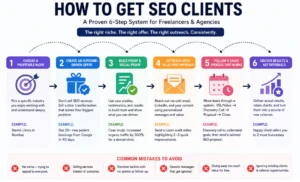
The foundation of everything is: niching down and defining a clear outcome. Imagine two pitches: “We do SEO” vs. “We get D2C skincare brands 3× ROAS on Facebook ads”. The second stands out. Similarly, specify your SEO niche and promise: e.g. “We help dental clinics rank #1 on Google and get 5 new patient bookings per month.”
Why this matters: UAbility data shows that moving from generic to niche + high-ticket can raise your average retainer from ₹10K to ₹50–150K/month without doing any new work. Co.agency warns that vague messaging doesn’t convert. So brainstorm: who do you love working with, and what SEO result can you reliably deliver?
A strong niche-offer has three parts (UAbility framework):
- Specific Target: Who exactly? (e.g. “law firms in Delhi”, “vegan restaurants in Bangalore”).
- Painful Problem: What exact issue do they face? (e.g. “no traffic from Google”, “zero leads from website”).
- Measurable Outcome: What result will you deliver? (e.g. “50 qualified leads/month from organic search”, “rank top 3 for 3 keywords in 90 days”).
Good niche example from UAbility: a content writer promising “Page 1 SEO blog content that ranks for SaaS companies in India”. Bad niche (too broad): “I write content for all businesses.”
After you pick a niche, update your messaging everywhere. Your website, LinkedIn, proposals all should reflect this. Instead of saying “I offer SEO,” say “I help [niche] achieve [specific result]”. This makes prospects feel like you’re speaking directly to them.
Step 2: Build Proof – Case Studies & Social Proof
Once you have a niche and outcome, you need proof. Prospective clients will trust you faster if they see concrete results. As co.agency points out, “If there is one thing that consistently attracts SEO clients, it is strong proof of your results”. The best proof is a case study.
How to Create Case Studies: Even if you have no clients yet, you can spin small wins into proof. Do a mini-project (even at a discount or gratis) for a friendly business in your niche, then document it. Use the classic “story” structure:
- Starting Point: Where was the client before? (“Clinic’s site was on page 5 for ‘best dentist in Mumbai’.”)
- Strategy: What did you do? (“We overhauled their on-page SEO, fixed speed issues, and built 5 local citations.”)
- Results: What changed? (“Within 3 months they went from 50 to 500 organic visitors per month and got 20 new patient calls.”).
Include before/after metrics (traffic, leads, rankings). If you can’t use real names, anonymize or say “Dental Clinic (Mumbai)”. Add client logos or video testimonials if possible.
Quick Case-Study Examples:
- “Dental SEO Success (Mumbai Clinic).” A dentist hired us for a trial SEO project on 5 local keywords. After 90 days, her site reached Page 1 for “best dentist Mumbai” and she gained 12 new patient appointments/mo (vs 1 before). Today her retainer is ₹80K/mo.
- “Local Retail Store.” An e-commerce shop selling handicrafts saw zero Google traffic. We optimized their site and Google Business Profile. Within 2 weeks, their products started ranking and they saw ₹50K in orders from organic search in the first month. The client then agreed to a ₹40K/mo SEO contract.
These are quick stories (like pitches). The point is to make readers visualize the outcome. When you later email prospects, you can point to these case summaries. Showing this is what we did for others in your niche is compelling.
Example Citation: “Even two or three strong case studies give prospects a reason to pick you over someone who just lists services”.
Aside from case studies, gather testimonials and logos: “Jane Doe, Founder of XYZ Ltd.” saying a line about results. Display them on your site and proposal to boost credibility. And of course, practice what you preach – get your own site and LinkedIn to rank for SEO terms in your niche. (If prospects find you on Google, half the battle is won.)
Step 3: Outreach – Targeted Channels That Actually Work
With niche and proof in place, it’s time to reach out. Below are the channels that move the needle, adapted to our UAbility approach:
Cold Email Outreach (High-Ticket Way): Cold emails can be gold if done right.
Subject: Quick question about [Company]’s Google visibility
Hi [First Name],
I noticed your [city/service] page isn’t ranking in Google’s top results for “[relevant keyword].” Right now, [Competitor A] and [Competitor B] are above you, likely getting traffic and leads that could be yours.
I put together a quick list of improvements you could make. Happy to send it over if you’re interested.
[Your Name]
[Your Company/Website]
Key tips: Always personalize. Mention a real fact (a competitor, a recent win they posted, etc.). Then “hot” lead: offer a free audit snippet. This is where UAbility’s Loom strategy shines: record a 2–3 minute Loom video audit highlighting 2-3 issues on their site, and email that video link. It’s proof you looked, and it sparks response. Saleshandy calls follow-ups “must” – email 2 offers more insights, email 3 shares a case study, etc..
- Cold Email Template #1 (Outreach): See above. You can tweak it. Use merge tags (company name, keywords) so it doesn’t feel copy-paste. UAbility calls this “putting content before pitch” – you lead with value, not your award-winning agency story.
- LinkedIn & Content Outreach: Don’t spam LinkedIn DMs. Instead, become a content authority. For instance, share a mini case study (“How I helped a [niche] client get 50 leads from Google”) or a carousel of quick SEO tips for that industry. The goal is to warm up prospects.
- Content Marketing: Beyond your site, publish valuable resources – weekly blog posts, YouTube tutorials, webinars. FatJoe suggests free tools, ebooks, or videos, but again with UAbility spin: niche content. For example, make a 10-min YouTube video “Local SEO for Plumbers: 3 Fixes in 3 Minutes” and share it on LinkedIn. Or write a blog “5 Mistakes [Industry] CEOs Make in SEO” and run Facebook/LinkedIn ads to it.
- Freelance Platforms (as a Stepping Stone): If you truly have zero clients, using Upwork/Fiverr can kickstart your proof of concept. But do it smart: niche your profile (e.g. “Shopify SEO expert for clothing brands” instead of “SEO services”). Land 3–5 projects at lower rates just to build reviews, then raise your rates for new clients. However, UAbility’s advice is clear: treat this as a short-term strategy. The goal is to graduate off these platforms quickly, not get stuck on them. Once you have those initial case studies and reviews, you can stop bidding and focus on direct outreach.
- Referrals and Partnerships: Word-of-mouth remains powerful. Co.agency reminds us not to “underestimate your existing network”. Tell friends, former colleagues, local business groups that you’re doing SEO for [niche]. Offer a referral fee for anyone who sends you a client. Also ally with complementary businesses: web designers, marketing coaches, local agencies. .
In short, use a mix of outbound (email, LinkedIn messages) and inbound (content, SEO) channels – but only after you have the above foundations. UAbility’s VSL funnels and email sequences live on this infrastructure.
Step 4: The Outreach-to-Sales Funnel (VSL → Discovery → Close)
Once you attract interest, you need a repeatable sales process. UAbility emphasizes a dialogue-based sales approach rather than hard-selling. A typical funnel looks like: Free Value (audit video or resource) → Discovery Call → Proposal/Close.
Video Sales Letter (VSL): Before a call, consider sending a short (2–3 minute) video personally addressing the prospect. This is the “Loom approach” on steroids. In the video (imagine it like a mini VSL), you highlight what you saw on their site and tease results you can deliver. When done well, prospects will immediately book a call to learn more. (UAbility even builds entire VSL funnels for clients at scale.)
Discovery Call: On the call, sell the transformation, not the features. Ask questions to uncover their pain and then present your tailored solution. Use the case studies you’ve prepared as proof. Remember, clients paying high fees expect a consultative approach. They want to feel understood and guided, not sold to.
SEO Proposal Outline: When you send a proposal after the call, it should be concise and outcome-driven. A best-practice SEO proposal structure is:
- Executive Summary: Recap their problem and your proposed outcome. (E.g. “You need 30 new leads/month; here’s how we’ll do it.”)
- Scope & Deliverables: Outline specific activities (keyword research, content, link outreach) but each tied to the promised result.
- Timeline: Milestones (Month 1: on-page fixes; Month 2: content rollout; etc.).
- Investment: Your fee (preferably per month) and payment terms. Anchor it to ROI: e.g. “For ₹X, you’re getting a system that brings Y inquiries; each customer is worth ₹Z.”
- Guarantee/Term: You might offer a short-term guarantee (UAbility faculty often teaches “refund if no result” as long as they do their part). Keep terms simple.
- Call to Action: Next steps – usually a signature page or scheduling the kickoff call.
The proposal should feel like a partnership plan, not a dry service list. Branding it well (PDF with your logo), and keeping it 2–3 pages helps it get read.
Step 5: Common Mistakes to Avoid
Before finishing, let’s list pitfalls:
- Mistake: Chasing Clients Everywhere. Don’t spray multiple channels with a generic pitch. Instead, choose 2–3 approaches and do them well. For example, run a cold email campaign and post consistently on LinkedIn for 3 months. Don’t also start Instagram, cold calling, and Google Ads at once. Depth beats breadth.
- Mistake: Generic Messaging. A cold email that reads “We increase SEO traffic for all companies” is noise. Always reference their niche and specifics. “I saw X vs Y on your site” shows you did your homework.
- Mistake: No Follow-Up. First outreach often fails. Schedule 3–4 touchpoints. Each follow-up should add value (a new tip, a case study, or just a polite nudge), not just “looping back”.
- Mistake: Selling Features Instead of Outcomes. When writing outreach or proposals, focus on the result. If you say “we do link building and content,” prospects will yawn. If you say “we’ll get you X leads” or “rank you on page 1 for [keyword]”, they listen.
- Mistake: Giving Away Too Much for Free. FatJoe lists dozens of free tactics (e.g. free directories, tools, postcards). While some freebies can be effective, UAbility warns against “free consulting” that doesn’t lead anywhere. If you do free audits or trials, make sure there’s a clear next step. For example, if you offer a 1-hour free site audit, say “this is a snapshot; to maintain this growth we’ll need a monthly program” in your pitch. The free work should create a lead into paid work, not just satisfy curiosity.
- Mistake: Ignoring Existing Clients. Once you land a client, keep doing great work and ask for referrals. A happy client is your best sales rep. Make it easy: some agencies send out a “Do you know anyone who needs marketing help?” email after 60 days. Even co.agency notes that keeping clients is “the most underrated part” of getting more clients. Don’t burn bridges or become ghost-like after signing a deal.
FAQs
Q: How quickly can I get my first SEO client?
With a focused system, often within 2–6 weeks. Start by tapping your network and sending 50–100 personalized cold emails (with Loom videos). According to UAbility data, the first discovery calls book in 1–2 weeks of consistent outreach, and the first paid high-ticket client closes in 2–6 weeks if you follow up diligently. If you pick up the phone or meet referrals, it can be even faster. Remember, the key is consistency – send 10 personalized pitches every day.
Q: What’s a realistic price to charge for SEO services?
Throw out that old ₹5K/month mindset. In 2026’s market, high-ticket SEO retainer rates typically range ₹40K–₹150K+ per month, depending on results promised. Price is justified by outcome. For example, if you deliver 3× ROI, a client will happily pay ₹1L/mo. Even as a beginner, don’t sell yourself short – use outcome-focused offers to justify premium pricing.
Q: Is cold emailing still effective for SEO clients?
Absolutely – when done right. Generic spam doesn’t work, but a personalized email with a quick audit or insight can get responses. UAbility adds: combine it with a 1–2 minute Loom video showing them a clear issue. That approach (the “Loom outreach”) often gets a 10–15% reply rate, which is much higher than text alone.
Q: Should I use Upwork/Fiverr or focus on direct outreach?
If you need clients right now to build a portfolio, start on Upwork but with strategy: niche down and underprice to get 3–5 reviews. But don’t rely on it. UAbility’s model is to quickly move off platforms and onto direct outreach/paid methods once you have proof. Direct methods yield better long-term clients and higher rates. Think of platforms as a short training ground, not a destination.
Q: What should I include in a winning SEO proposal?
Focus on what the client gets. Start with an executive summary of their problem and your solution (e.g., “We’ll get [Company] page 1 rankings for 5 key local terms in 3 months”). Then outline deliverables (keyword optimization, content, links) tied to those goals, a timeline, and investment. Case studies or testimonials in the appendix can clinch it. Remember, the proposal is part of selling your transformation, so lead with outcomes and ROI, not a laundry list of tasks.