Since joining UAbility, I implemented the VSL funnel and the SLOSHED Framework, which helped me close 19 sales and generate ₹8.3 Lakhs in revenue. My AOV jumped from ₹24K to ₹50K, and I even achieved 22.58X & 36.8X ROAS. The experience has been amazing — got clarity, confidence, and consistent results!
Since joining UAbility, I implemented the VSL funnel and the SLOSHED Framework, which helped me close 19 sales and generate ₹8.3 Lakhs in revenue. My AOV jumped from ₹24K to ₹50K, and I even achieved 22.58X & 36.8X ROAS. The experience has been amazing — got clarity, confidence, and consistent results!
No portfolio, no clients yet? Learn exactly how to get high ticket clients in India from scratch proven frameworks, real case studies, step-by-step outreach.
Getting high ticket clients is not about luck, a huge following, or years of experience.
It is about doing three things right: picking the right niche, positioning your value clearly, and having the right conversation with the right person.
This guide covers everything whether this is day one with zero clients, or whether earning Rs 1–2 lakhs a month feels like a ceiling that will not budge. Both stages get specific answers here.
What Is a High Ticket Client?
A high ticket client pays premium prices because they are buying a clear, specific outcome not just a service or a deliverable.
High ticket is not just a higher price. It is a fundamentally different business model.
High ticket pricing in the Indian market typically looks like this:
Category
Low Ticket
High Ticket
Coaching programme
Rs 3,000 – Rs 10,000
Rs 50,000 – Rs 5,00,000+
Agency retainer
Rs 8,000 – Rs 20,000/mo
Rs 50,000 – Rs 2,00,000+/mo
Freelance project
Rs 5,000 – Rs 25,000
Rs 50,000 – Rs 5,00,000+
Clients needed for Rs 1L/month
15 to 30
2 to 3
The same skill can be sold at Rs 8,000 or Rs 80,000. The difference is never the skill. It is the positioning.
A web developer who sells “websites” charges Rs 15,000. A web developer who sells “a conversion-optimised site that generates 5–10 qualified enquiries per week for service businesses” charges Rs 1,50,000 for the same technical work.
Guides
How to land high ticket clients as a web developer
Before getting into the how, it helps to understand why this feels so hard.
Most coaches, freelancers, and agency owners are trapped in one of three cycles:
The Volume Trap. Taking 15 low-paying clients to cover monthly expenses leaves no time to attract better ones. So more low-paying clients get taken on. The cycle repeats.
The Credibility Trap. Believing more experience is needed before charging more, so lower rates are offered to gain experience. But clients who pay Rs 5,000 do not refer Rs 50,000 clients. The experience never translates.
The Comparison Trap. Looking at what competitors charge and pricing just below it. This makes the service a commodity and price becomes the only differentiator.
All three cycles break the same way: pick one specific niche, charge based on the outcome delivered, and learn to have the right high ticket sales conversation.
Stage 1: No Clients Yet (Rs 0 to Rs 1 Lakh/Month)
If you’re wondering how to earn ₹1 lakh per month without a portfolio, testimonials, or an established reputation, this section is for you. Many people assume they need years of experience before charging premium prices, but that’s rarely true. With the right positioning, offer, and client acquisition strategy, it’s possible to earn ₹1 lakh per month even when you’re starting from scratch.
Step 1: Define Your Niche With Precision
The fastest path to a high ticket client is to become known for solving one expensive, painful, specific problem for one specific type of person.
“Digital marketing” is not a niche. “Facebook ads for D2C fashion brands in India doing Rs 10–50 lakhs in monthly revenue” is a niche.
Use this four-question framework to define yours:
Question
What to Write Down
Who do you serve?
One specific type of person or business
What problem do you solve?
One painful, urgent problem they have
What outcome do you produce?
Measurable result in a defined timeframe
Why you over anyone else?
Your unique angle, method, or background
The answers to these four questions become everything: the outreach message, the offer, the price, and the sales conversation.
Step 2: Build Credibility Without a Portfolio
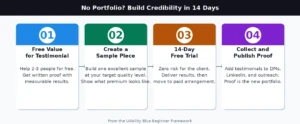
The single most common reason beginners do not start is the portfolio problem. Here is the exact four-step credibility framework used in the UAbility Blue programme:
Method 1: Serve for free, get documented proof.
Pick two or three people in your target niche and offer genuine help at no cost in exchange for a specific, written testimonial. Not a “thanks bro” on WhatsApp. A testimonial that names the problem, describes what happened, and ideally includes a measurable result.
Method 2: Create a sample piece at target quality.
For anyone in a deliverable-based field web development, design, copywriting, social media build one sample piece at the quality level that would justify a Rs 50,000+ price. Most beginners skip this. Doing it alone puts the offering ahead of 90% of competitors.
Method 3: Offer a 14-day free trial.
Approach a potential client with: “Work with us for 14 days at no cost. If we deliver results, a paid arrangement gets discussed. If not, an honest testimonial is all that is owed.” This is near-zero risk for the client and almost always converts to paid once results are delivered.
Method 4: Document the journey publicly.
Sharing what is being learned, tested, and discovered builds perceived expertise before client results exist. A post titled “Here is what was found after analysing 10 top-performing email funnels” builds more credibility than “hire us, we do email marketing.”
Step 3: Identify 30 Ideal Prospects
Most beginners trying to get freelance clients rely on random outreach or job platforms. High ticket client acquisition works differently. Do not send mass messages. Make a list of 30 specific people or businesses that match the ideal client profile exactly.
For each one, spend five minutes researching:
What are they currently doing?
What results are they publicly sharing?
What is the visible gap between where they are and where they want to be?
Is there a specific problem visible from the outside that they may not have noticed?
This research becomes the entire foundation of the outreach message.
Step 4: Send Outreach That Gets Replies
Most outreach fails because it is about the sender, not the recipient. Here is the difference:
The right message is specific, personalised, leads with value, and asks for almost nothing. It demonstrates that the work has already been done. That is what gets replies.
The outreach sequence:
Send the personalised, value-first opening message
If no reply in 3 days, follow up with one additional piece of value or observation
On the third touchpoint, ask directly if a 15-minute conversation would be useful
If still no reply, move on. Do not push. The goal is conversations with ready buyers, not convincing resistant ones.
Step 5: The Discovery Conversation
When a prospect replies and shows interest, the instinct will be to pitch. Resist this entirely.
Instead, ask questions to understand their situation before presenting anything:
“What is the biggest challenge right now with [the area you help with]?”
“What have you already tried? What worked and what did not?”
“What would solving this actually mean for the business in the next six months?”
These questions do two things simultaneously. They reveal whether this person can genuinely be helped. And they help the prospect articulate their own pain which means by the time a solution is presented, they have already convinced themselves the problem is worth solving.
This is the foundation of UAbility’s dialogue-based advisory selling method. It is not selling. It is advising. The sale happens naturally at the end of a conversation where the prospect feels genuinely understood.
Step 6: The Pricing Conversation
When the time comes to discuss price, anchor to the outcome not the deliverable.
Before any number is mentioned: “You mentioned that fixing your client acquisition would add roughly Rs 3–4 lakhs per month in revenue. If that happened in the next 90 days, what would that be worth?”
Then present the price with complete confidence and go silent. Do not apologise for it. Do not volunteer a discount before being asked. Silence after a price is normal. Let it sit.
When “I’ll think about it” comes up, ask: “Is it the investment itself, or is it confidence that this will actually work for the specific situation?” This opens the real objection and allows addressing the actual hesitation.
Stage 2: Already Earning But Stuck Under Rs 5 Lakhs/Month
For those already working with clients but feeling like the growth has stalled, the problem is almost never skill. It is one of four things:
1. The niche is too broad. Serving too many types of clients means the positioning is unclear and premiums cannot be charged for specialisation.
2. The offer is a commodity. If the pitch sounds like everyone else’s pitch, price becomes the only differentiator. Differentiate on method, outcome, and guarantee.
3. The sales process has no structure. Most people at this stage are winging discovery calls. A structured conversation framework that consistently leads prospects to a decision makes conversion rates dramatically higher.
4. Referrals are the only channel. Referrals are unpredictable. Scaling requires a predictable outbound or inbound system.
Moving From Aspirer to Go-Getter: What Changes
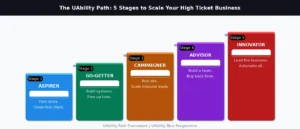
The UAbility Path maps the exact progression from Rs 0 to Rs 1 crore per month. Here is what each stage requires:
Stage
Revenue
Primary Focus
Biggest Need
Aspirer
Rs 0 – 1L/mo
Pick niche, close first clients
Product-market fit
Go-Getter
Rs 1 – 5L/mo
Build hybrid delivery system
Consistent cash flow
Campaigner
Rs 5 – 15L/mo
Non-linear marketing system
High-quality lead flow
Advisor
Rs 15 – 35L/mo
Leveraged course, step back from sales
Buying back time
Innovator
Rs 35L – 1Cr/mo
Build coaching and delivery team
Quality control at scale
Most people earning Rs 1–3 lakhs per month are stuck between Aspirer and Go-Getter. The transition requires one shift: moving from manually delivering everything to building a repeatable system where 50% of the process is taught to the client, freeing time to take on more clients.
The Three Levers to Break the Ceiling
Lever 1: Raise prices and reduce client count.
If currently serving 8 clients at Rs 15,000 each for Rs 1,20,000 per month, moving to 3 clients at Rs 50,000 each produces the same revenue with a third of the clients. More time per client means better results, which means better testimonials, which justifies even higher prices.
Lever 2: Add one structured outbound channel.
Pick one LinkedIn, Instagram DM, cold email and run a proper outbound system. Thirty personalised messages per week with consistent follow-up will generate 2–4 discovery calls per week within 30 days in almost every niche.
Lever 3: Systematise the sales conversation.
At this stage, most people are having unstructured calls and hoping for the best. A consistent discover call framework with defined questions, a clear structure, and a rehearsed transition to pricing typically increases close rates by 30–50%.
The High Ticket Mindset Shift
This is the part most guides skip, and it is the part that actually determines whether the pricing holds.
High ticket earners sell transformation. Every other earner sells their time.
When a logo is sold for Rs 5,000, time and deliverable are being sold. When a brand identity is sold for Rs 75,000 that positions a business to attract premium clients, a transformation is being sold.
The deliverable may be similar. The outcome is completely different. And the outcome is what justifies the price.
This shift has to happen internally before it can happen in conversations. If the belief is not there that what is being offered creates a transformation worth paying Rs 50,000 for, body language, pricing, and follow-up will all undermine it regardless of how good the scripts are.
Common Mistakes That Keep People at Low Ticket
Mistake
Why It Hurts
The Fix
Building a website before getting clients
Wastes time on the wrong priority
Get 2-3 clients first, build website with their testimonials
Posting content and waiting for inbound
Takes 6–12 months to generate leads
Do outbound first, add content later
Pricing based on competitors
Makes the service a commodity
Price based on the outcome delivered
Discounting at first sign of resistance
Trains the client to not take the price seriously
Ask what the real concern is; address it without discounting
Going too broad
Cannot charge a specialist premium
Narrow the niche until it feels uncomfortable
Pitching in the first message
Gets ignored or blocked
Lead with value, never with a pitch
Real Results: What Happens When the Framework Is Applied
These are UAbility clients who started at or near zero:
30-Day Action Plan: From Zero to First High Ticket Client
Week
Focus
Specific Actions
Week 1
Foundation
Define niche using 4-question framework. Write one-sentence positioning statement. List 30 ideal prospects by name.
Week 2
Credibility
Help 2–3 people for free. Collect documented testimonials. Create one sample portfolio piece.
Week 3
Outreach
Send personalised, value-first messages to all 30 prospects. Follow up with everyone who engages. Book 5–10 discovery calls.
Week 4
Close
Run structured discovery conversations. Present offer to qualified prospects. Close the first high ticket client.
The only thing standing between where things are now and a Rs 50,000+ client is executing this sequence. One client changes the entire psychology of what is possible. Everything after that is about refining and scaling the system.
What to Do Right Now
If you’re ready to put these strategies into practice, UAbility Blue – High Ticket Coaching Program is designed for coaches, consultants, freelancers, and agency owners who are serious about building a high-ticket business.
Founded by Rohan Dhawan, a high-ticket client acquisition specialist and business coach, UAbility helps service providers build the systems needed to attract and convert higher-paying clients. The programme covers niche selection, offer creation, outreach systems, sales call frameworks, and delivery, with accountability built in throughout.
If you’re looking for a structured way to move from finding clients to consistently acquiring high-ticket clients, explore UAbility Blue and see if it’s the right fit for your business.
No. The first several high ticket clients will come from direct conversations outbound DMs, referrals, and warm outreach. A website becomes valuable once testimonials and case studies exist to put on it. Build the proof first.
How long does it take to land the first high ticket client?
With focused outbound outreach of 20–30 personalised messages per week with genuine follow-up, most people land their first high ticket client within 2–6 weeks. Swagatam did it in 17 days. The timeline depends almost entirely on how quickly conversations happen and how clearly the niche is defined.
Can someone really charge Rs 50,000+ as a beginner?
Yes if the outcome delivered is worth that to the client. A beginner who helps a business owner generate Rs 5 lakhs in new revenue can absolutely charge Rs 50,000. The price reflects the outcome, not the years of experience.
What is the difference between high ticket and normal pricing?
Normal pricing sells time or deliverables per hour, per post, per design. High ticket pricing sells outcomes and transformation. The same service can be positioned either way. The positioning is the entire difference.
What do you say when a prospect says the price is too high?
Never discount immediately. Ask: "Is it the investment itself that is the concern, or is it confidence that this will work for the specific situation?" Most hesitation is about certainty of results, not the absolute number. Address the certainty first.
What if there are no testimonials yet?
Use the four-step credibility framework: serve someone for free in exchange for a documented testimonial, create a sample portfolio piece, offer a 14-day free trial, or document expertise through content. Any one of these creates enough credibility to start the high ticket conversation.
What is the UAbility Path?
The UAbility Path is a five-stage framework mapping the journey from Rs 0 to Rs 1 crore per month: Aspirer (Rs 0–1L), Go-Getter (Rs 1–5L), Campaigner (Rs 5–15L), Advisor (Rs 15–35L), and Innovator (Rs 35L–1Cr). Each stage has a different primary focus, team structure, biggest need, and set of internal challenges.
Is cold outreach still working in 2026?
Yes but only personalised, research-backed, value-first outreach. Mass DMs and copy-paste messages do not work and damage credibility. A message that demonstrates specific knowledge of the prospect's business and leads with genuine help gets replies consistently.
Subscribe to our newsletter!
Browse Similar Blogs
How to Make ₹1 Lakh Per Month Without Working More Hours
Rs 1 lakh per month. That is the number most Indians think about when they want to escape financial stress...