High ticket sales is the practice of selling premium products or services typically priced at $1,000 or above for B2C and $10,000 or above for B2B where the buyer is purchasing a defined outcome rather than a deliverable or unit of time.
At this price level, the sales process fundamentally changes. Buyers conduct extensive independent research, involve multiple stakeholders in the decision, and expect a consultative conversation that diagnoses their specific problem before any solution is presented.
The mechanics of high ticket sales positioning, pricing, the sales conversation, and closing are covered in depth here. For the specific question of how to get high ticket clients from scratch, the complete acquisition playbook covers that in full.
What Is High Ticket Sales?
High ticket sales is not defined by a single price point. It is defined by what the buyer is purchasing. When the purchase is a transformation, an outcome, or a solution to a critical business problem rather than a deliverable, a session, or a product unit it qualifies as high ticket regardless of the exact number.
| High ticket is a positioning decision before it is a pricing decision. The price follows the positioning it does not create it. |
High Ticket Sales in 2026: What the Data Shows
The market for high ticket services has shifted significantly. Buyers are better informed, more self-directed, and more resistant to traditional sales approaches. Here is what the current data says:
- Buying committees now average 13 decision-makers per high ticket B2B deal, up from 6 to 8 just three years ago (Martal Group, 2026). This means a single stakeholder champion is rarely enough to close a deal.
- 75% of B2B buyers prefer a rep-free buying experience, yet 70% of buyers still complete $50,000+ purchases entirely through remote digital interactions (Corporate Visions / Martal Group, 2026). Buyers want self-service research and human expertise at the moment of decision.
- Buyers spend only 17% of their total purchase journey in direct conversation with any vendor. The remaining 83% is independent research, internal consultation, and peer referral (Gartner, 2026).
- Only 33% of sales professionals consistently hit their targets in 2026 (UpLead, 2026). The gap between quota attainment and actual performance is at a multi-year high.
- 89% of revenue organisations have adopted AI tools in their sales process as of 2026, up from just 34% in 2023 (Martal Group, 2026). AI is now table stakes, not a competitive advantage.
- Sales professionals who use social selling are 51% more likely to hit quota (SPOTIO, 2026), and 31% have reported closing deals worth over $500,000 without a single in-person meeting (Phoenix Consulting, 2026).
| The single most important implication: 83% of the buying decision is already made before the sales conversation begins. High ticket sales is won or lost long before the discovery call through positioning, proof, and content that works while the seller is not in the room. |
High Ticket Sales Examples Across Industries
High ticket sales exists across every service-based category. The examples below represent the most common categories where the model is applied and the pricing ranges observed in 2026:
| Category |
High Ticket Example |
2026 Price Range |
| Business Coaching |
Structured transformation programme with defined outcomes |
$3,000 – $25,000 |
| Marketing Agency |
Full-service lead generation or paid ads retainer |
$2,500 – $12,000/mo |
| Consulting |
Strategy and implementation engagement with accountability |
$5,000 – $50,000+ |
| Mastermind Programme |
Group coaching with peer accountability and expert access |
$5,000 – $15,000/year |
| Fitness / Health |
Body transformation or performance programme with check-ins |
$2,000 – $6,000 |
| Web / Tech Services |
Conversion-focused development with guaranteed outcomes |
$3,000 – $30,000 |
| Enterprise SaaS |
Annual software licences with onboarding and support |
$10,000 – $500,000+ |
Across every category, the pattern is identical: the high ticket version is sold as a defined result within a defined timeframe not hours worked, deliverables produced, or sessions attended. This one reframe changes the buyer profile, the price point, and the entire sales conversation.
The UAbility Blue sales coaching programme has tracked this comparison across 1,400+ clients. The data from the Elite 3.0 framework which underpins the programme makes the business case clear across three pricing models:
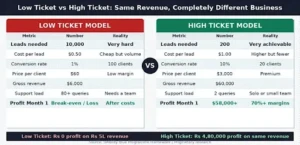
One-Time Project: The Margin Gap
| Metric |
Low Ticket |
High Ticket |
| Leads required to reach $6,000 revenue |
10,000 leads at $0.05 cost |
200 leads at $0.10 cost |
| Lead acquisition cost |
$500 total |
$20 total |
| Conversion rate |
1% (100 clients) |
1% (2 clients) |
| Price per client |
$60 |
$3,000 |
| Gross revenue |
$6,000 |
$6,000 |
| Support load |
80+ queries requiring staff |
1-2 queries, manageable solo |
| Net profit |
Break-even or loss |
$5,980 (99.7% margin) |
Subscription / Retainer: The Compounding Advantage
At retainer pricing, the gap compounds month over month. Low ticket subscription businesses lose clients through churn faster than they acquire new ones at scale. High ticket retainer clients having made a significant investment are more committed, follow the programme, and stay longer.
The coaching industry maintains gross profit margins of 46% to 90% at high ticket pricing (BusinessDojo, 2026). The same expertise generating 46% margins at low ticket generates 85%+ margins at premium pricing with fewer clients to manage.
| The high ticket model is not just more profitable. It is a structurally different business: fewer clients, deeper relationships, lower operational complexity, and dramatically higher margins. The question is never whether high ticket is better the question is how to position for it. |
How High Ticket Sales Works: The Mechanics by Deal Type
The mechanics of high ticket sales differ significantly depending on the deal type. Coaching and consulting operate differently from B2B enterprise. Understanding the distinction prevents applying the wrong approach to the wrong buyer.
High Ticket Coaching and Consulting Deals
For coaches, consultants, and agencies, the typical high ticket sales cycle runs 1 to 4 weeks from first contact to close. The buyer is usually a single decision-maker a business owner or professional who has already done their research and is evaluating providers. The key factors in their decision are certainty of outcome, proof of results with similar clients, and trust in the seller’s ability to understand their specific situation.
| Stage |
What Happens |
What the Buyer Needs |
| Discovery |
30 to 60 minute structured conversation |
To feel genuinely understood, not pitched at |
| Proposal |
Outcome-specific offer tied to their stated goals |
Clear ROI relative to the investment |
| Decision |
1 to 7 days of internal consideration |
Proof that this works for people like them |
| Close |
Verbal commitment followed by payment |
Confidence in the outcome and the person delivering it |
High Ticket B2B Enterprise Deals
Enterprise deals are a different category. Average buying committees now include 13 decision-makers across finance, IT, procurement, operations, and the C-suite each with different concerns and different objections (Martal Group, 2026).
Closing at this level requires multi-threading: building relationships across the buying committee simultaneously rather than relying on a single champion to carry the deal internally. Research from Gong confirms that multi-threading boosts win rates by 130% on deals over $50,000.
| Stakeholder |
Primary Concern |
What They Need to See |
| Finance / CFO |
ROI and cost justification |
Quantified return within a defined timeframe |
| IT / Technical |
Implementation risk |
Security documentation, integration specs, support SLAs |
| End Users |
Usability and workflow impact |
Demonstration, pilot results, peer testimonials |
| Procurement |
Vendor risk and contract terms |
References, compliance certificates, case studies |
| C-Suite |
Strategic alignment |
How this solves a problem at the business level, not the tool level |
The implication for sellers: a single compelling pitch delivered to one stakeholder is insufficient for B2B high ticket deals. Each stakeholder needs specific evidence tailored to their concern. Sales teams that build multi-stakeholder content ROI calculators, security questionnaires, implementation timelines close at significantly higher rates than those relying on a single proposal document.
Why Traditional Pitching Fails at High Ticket
Buyers at high ticket price points are not impulse purchasers. They have budgets to justify, stakeholders to convince, and reputations to protect. A traditional pitch one that focuses on features, availability, and urgency triggers resistance rather than trust.
What the Buyer Is Actually Evaluating
Research by Corporate Visions (2026) finds that B2B buyers arrive at sales conversations with AI-assisted research already completed, a pre-ranked shortlist of providers, and a decision process shaped by peer networks they never mention. The seller is often the last step, not the first.
What the buyer is actually evaluating in the conversation:
- Does this person understand my specific situation or are they running a generic script?
- Have they solved this exact problem for someone like me before, and can they prove it?
- Do they seem genuinely interested in my outcome, or primarily in closing the sale?
- Is the risk of this investment acceptable relative to the cost of the problem remaining unsolved?
Every element of the sales conversation should answer these four questions not through claims, but through the quality of the questions asked, the accuracy of the diagnosis delivered, and the specificity of the proof presented.
The Sales Conversation Structure That Works
The dialogue-based advisory selling approach developed and refined across UAbility Blue’s 1,400+ clients is built around a simple principle: the seller speaks less than the buyer in the first half of any discovery conversation.
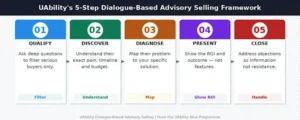
The UAbility Dialogue-Based Advisory Selling Framework from the UAbility Blue Programme
The framework has five stages: qualify before booking the call, discover the real depth of the problem, diagnose the root cause before prescribing any solution, present the outcome as a direct response to what the buyer has described, and handle objections with curiosity rather than counter-arguments.
The fundamental difference from traditional closing scripts: this approach makes the buyer feel that the sale is their idea. When a buyer articulates their own problem in their own words, and the seller reflects it back with accuracy, the emotional case for the solution is already made before any price is mentioned.
High Ticket Sales Funnel: From Stranger to Paying Client
A high ticket sales funnel is a structured sequence that moves a potential buyer from first awareness to a confident purchasing decision. Unlike volume funnels that optimise for lead quantity, high ticket funnels are built around lead quality and buyer readiness.
| Funnel Stage |
What Happens |
Primary Mechanism |
| Awareness |
Prospect discovers the offer |
Video Sales Letter, content, paid ads, outbound outreach |
| Interest |
Prospect engages with proof |
Case studies, testimonials, YouTube, written results |
| Consideration |
Prospect self-qualifies and books |
Application form, booking page, DM conversation |
| Decision |
Discovery call using advisory framework |
Structured 30 to 60 minute conversation |
| Close |
Commitment and payment |
Payment link, proposal, agreement |
| Retention |
Delivery and results |
Onboarding system, check-ins, transformation tracking |
The Video Sales Letter (VSL) Explained
The VSL is the most effective top-of-funnel mechanism for high ticket coaching and consulting. A well-built VSL addresses the prospect’s problem before they reach out, demonstrates the seller’s depth of understanding, presents proof through real client results, explains the methodology, and makes a clear offer in 15 to 45 minutes.
By the time a prospect books a call after watching a VSL, they are already partially sold. The discovery call becomes a qualification and commitment conversation rather than an education conversation. This dramatically reduces the sales cycle and increases close rates.
| The highest-performing UAbility Blue clients consistently report that prospects who come through a VSL funnel arrive knowing the price, having already decided they want to work together, and simply wanting to confirm the seller understands their specific situation. |
Outbound as the Starting Point
Most high ticket businesses start with outbound direct, personalised messages to ideal prospects before building inbound funnel infrastructure. This is correct sequencing. Outbound provides immediate feedback on positioning and offer clarity. A VSL funnel built before the positioning is proven wastes budget testing the wrong message at scale.
At the early stage, 30 highly personalised outbound messages per week to exactly the right prospect profile outperforms 300 mass messages to an undifferentiated list. Volume is not the variable relevance is.
What High Ticket Sales Training Actually Covers
High ticket sales training is one of the highest-searched related terms because most people who want to close premium deals know they need a structured skill set, not just motivation. Here is what legitimate training covers, and what it does not:
| Training Area |
What Is Covered |
The Outcome |
| Offer architecture |
How to build an offer around a defined outcome with a clear ROI |
A price that feels justified because the value is obvious |
| Ideal client definition |
How to identify buyers who have the problem, the urgency, and the budget |
Fewer wasted calls, higher close rates per conversation |
| Lead generation systems |
Outbound DM sequences, VSL funnel structure, paid traffic strategy |
A predictable flow of qualified conversations |
| Discovery call framework |
Qualification, diagnosis, presentation structure, transition to pricing |
10%+ close rate on qualified calls |
| Objection resolution |
Handling price, timing, trust, and previous-experience objections |
Objections become closing opportunities rather than deal-breakers |
| Pricing psychology |
Value anchoring, outcome-based framing, holding price under pressure |
Premium pricing that does not collapse under the first pushback |
The most common gap in high ticket sales training is the overemphasis on closing scripts and the underemphasis on discovery quality. Sellers who deeply understand the buyer’s situation close without needing scripted closes. The close is the natural conclusion of a conversation where genuine understanding was established.
Companies with strong sales enablement programmes see 49% higher win rates on forecasted deals compared to those without (Martal Group, 2026). Training is not optional at this level it is the primary lever for conversion rate improvement.
UAbility Blue: The High Ticket Sales Programme Built on 1,400+ Results
UAbility Blue is the structured programme for coaches, consultants, freelancers, and agency owners who want to build a high ticket business covering every element from positioning and offer design through to the full sales conversation framework and delivery systems.
| UAbility Blue
India’s Leading High Ticket Sales Programme
1,400+ clients. Trusted by coaches, consultants, and agencies across India and internationally. A 4% acceptance rate. Results from Aspirer stage to multiple crores. |
The programme is structured around five core pillars that directly address the highest-leverage bottlenecks in building a high ticket business:
| Pillar |
What It Covers |
The Business Outcome |
| Business Foundations |
Niche selection, market validation, offer architecture |
A clear high ticket offer positioned to a specific buyer |
| Client Acquisition |
Outbound DM systems, VSL funnel, Instagram/LinkedIn strategy |
Consistent flow of qualified discovery calls |
| Dialogue-Based Selling |
The 5-stage advisory conversation framework, objection handling |
10%+ close rate on qualified conversations |
| Delivery and Systems |
Client onboarding, results tracking, referral generation |
High client retention and compounding social proof |
| Scale and Leverage |
Paid ads, team hiring, group coaching models |
Move from one-to-one to leveraged revenue |
What UAbility Blue Clients Have Achieved
- Priyanka, Fitness Coach: Moved from no clients to Rs 37k per client by repositioning from sessions to a defined transformation programme.
High Ticket Sales Objections: What Buyers Say and What They Mean
Objections in high ticket sales are not the end of the conversation. They are the most important part of it. Each objection signals a specific gap between what the buyer currently believes and what they need to believe to move forward.
| The Objection |
What the Buyer Actually Means |
The Right Response |
| The price is too high |
The ROI has not been made tangible enough yet |
Quantify the cost of the problem remaining unsolved. Make the investment feel small relative to the outcome. |
| I need to think about it |
Something specific is unresolved |
Ask directly: Is it the investment, or confidence in the outcome for your specific situation? |
| I need to speak to my partner or team |
There is another decision-maker involved |
Offer to include them. A joint conversation closes faster than a second-hand relay. |
| I had a bad experience before |
They were burned by a poor solution |
Acknowledge it specifically. Show exactly what is different about this approach do not dismiss it. |
| Now is not the right time |
The problem is not yet urgent enough |
Explore what would make now the right time. Sometimes urgency needs to be created, not waited for. |
| Can you send me more information? |
They want to exit the conversation politely |
Ask what specific information would help them decide. Generic follow-up material almost never closes a deal. |
The most important rule for objection handling at the high ticket level: never discount the price as the first response to any objection. Discounting signals that the original price was not justified which destroys trust at the exact moment when trust is the deciding factor.
What Makes Someone an Effective High Ticket Sales Closer?
A high ticket sales closer is a person whose specific focus is converting warm, qualified prospects into paying clients usually at the final stage of the funnel after the prospect has engaged with content or gone through an application process.
In 2026, approximately 45% of high ticket sales roles in coaching, consulting, and agency businesses operate remotely (Martal, 2026). The closer does not need to be physically present. What they need is a mastery of three specific skills:
| Skill |
What It Looks Like in Practice |
| Diagnostic listening |
Asking questions that reveal the full depth of the buyer’s situation not surface-level problems but the underlying fear, goal, or business consequence |
| Value articulation |
The ability to reflect the buyer’s own words back to them in a way that makes the solution feel inevitable rather than pitched |
| Objection curiosity |
Treating every objection as a request for information rather than a barrier to overcome which changes the entire tone of the closing conversation |
Social selling fluency has also become critical for remote closers. Sales professionals who use social selling are 51% more likely to hit quota, and LinkedIn credibility increasingly substitutes for in-person trust-building in high-value remote deals (SPOTIO, 2026).
FAQs
What is high ticket sales?
High ticket sales is the practice of selling premium products or services priced at $1,000 or more for B2C and $10,000 or more for B2B where the buyer is purchasing a defined outcome rather than a deliverable or unit of time. The sales process is consultative, relationship-driven, and focused on demonstrating ROI rather than closing through speed or pressure.
What qualifies as a high ticket sale?
A sale qualifies as high ticket when the price reflects a significant transformation or business outcome. Coaching programmes above $1,000, consulting retainers above $2,500 per month, agency contracts above $3,000 per month, and enterprise software above $10,000 annually are all commonly classified as high ticket. The threshold varies by category, but the defining characteristic is always the nature of what is being sold: an outcome, not a deliverable.
What is the average high ticket sales close rate in 2026?
Industry benchmarks put the average close rate for high ticket deals at 29% overall. However, with a structured discovery call framework, proper lead qualification, and outcome-based positioning, close rates of 10% to 15% per qualified conversation are consistently achievable. The key variable is lead quality, not sales technique unqualified leads will not close regardless of the script used.
How long does a high ticket sales cycle take?
For coaching and consulting, the sales cycle typically runs 1 to 4 weeks from first contact to close. For B2B enterprise deals, cycles run 3 to 9 months depending on buying committee size and procurement processes. In 2026, buying committees average 13 decision-makers per high ticket B2B deal, which extends cycles but also creates more opportunities to build internal champions.
What is a high ticket sales funnel?
A high ticket sales funnel is a structured sequence moving a potential buyer from awareness to a purchasing decision. The stages are awareness, interest, consideration, decision, and close, with a Video Sales Letter (VSL) commonly serving as the top-of-funnel mechanism. Unlike volume funnels, high ticket funnels prioritise lead quality over lead quantity a VSL that books 10 highly qualified calls outperforms one that books 100 poorly qualified ones.
What is high ticket sales training?
High ticket sales training is structured education covering offer architecture, ideal client definition, lead generation systems, discovery call frameworks, objection handling, and pricing psychology. Legitimate training focuses as much on the quality of the discovery conversation as on closing techniques because sellers who deeply understand the buyer's situation close without needing scripted closes. Companies with strong sales training see 49% higher win rates on forecasted deals (Martal Group, 2026).
What are high ticket sales examples?
Common examples in 2026 include: a business coach selling a 90-day transformation programme at $5,000 to $15,000; a digital marketing agency selling a lead generation retainer at $3,000 to $10,000 per month; a consultant selling a strategy and implementation engagement at $10,000 to $50,000; a fitness coach selling a 6-month body transformation programme at $2,000 to $5,000; and enterprise SaaS companies selling annual contracts above $10,000 with 8 to 13 decision-makers involved in the purchase.
Can high ticket sales be done online without in-person meetings?
Yes, and in 2026 it is the norm rather than the exception. Martal Group data confirms that 70% of B2B buyers complete purchases of $50,000 or more entirely through remote digital channels. High ticket coaching, consulting, and agency services are routinely closed through video discovery calls on Zoom, Google Meet, or similar platforms. Remote high ticket roles now represent approximately 45% of all high ticket sales positions (Martal, 2026).