Since joining UAbility, I implemented the VSL funnel and the SLOSHED Framework, which helped me close 19 sales and generate ₹8.3 Lakhs in revenue. My AOV jumped from ₹24K to ₹50K, and I even achieved 22.58X & 36.8X ROAS. The experience has been amazing — got clarity, confidence, and consistent results!
Since joining UAbility, I implemented the VSL funnel and the SLOSHED Framework, which helped me close 19 sales and generate ₹8.3 Lakhs in revenue. My AOV jumped from ₹24K to ₹50K, and I even achieved 22.58X & 36.8X ROAS. The experience has been amazing — got clarity, confidence, and consistent results!
No clients yet? Learn exactly how to get freelance clients without chasing low rates on Upwork. The high ticket approach for web developers, writers, designers and more.
Getting freelance clients as a beginner feels impossible until one thing clicks: the strategy that gets low-paying clients and the strategy that gets high-paying clients are completely different. Most guides teach the first. This one teaches the second.
India now has 15 million+ registered freelancers the largest freelancer base in the world (Affiliatebay, 2026). The competition for Rs 5,000 projects is brutal. The competition for Rs 50,000 to Rs 5,00,000 projects is almost non-existent, because almost nobody is positioning for it.
This guide is written specifically for beginners: people who have a skill, have no clients yet, and want to build something real not chase gigs on platforms competing against thousands of others.
India’s freelance market is growing at 25.1% CAGR and is projected to reach $25 billion in market size. The opportunity is enormous. The question is which part of the market to position for and most beginners are aiming at the wrong end.
What Most Freelancing Guides Get Wrong for Beginners
The standard advice for getting freelance clients is: create a profile on Upwork, bid on projects, build reviews, raise rates over time. This is not wrong. It is just the slowest, most competitive, and lowest-margin path available.
There are three problems with the traditional approach:
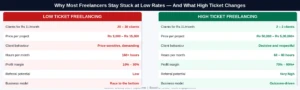
Volume platforms race prices to the bottom. When hundreds of freelancers bid on the same project, clients choose by price. The winner is whoever undercuts the rest. This is a race no one wins long-term.
Platform fees eat into already-thin margins. Upwork charges up to 20% on the first $500 earned with each client. On a Rs 10,000 project, that is Rs 2,000 gone before a single rupee reaches the bank.
Low-paying clients generate the most problems. Clients who pay Rs 3,000 for a website expect Rs 30,000 worth of revisions. Clients who pay Rs 1,00,000 trust the process and respect the expertise.
The data from UAbility Blue’s 1,400+ clients confirms this consistently. Freelancers who start at high ticket pricing even as beginners build momentum faster, attract better clients, and burn out less than those who compete on volume at low rates.
What High Ticket Freelancing Actually Means for a Beginner
High ticket freelancing is not about charging more for the same thing. It is about repositioning what is being sold from a service or deliverable to a defined business outcome.
A web developer who sells websites charges Rs 15,000. A web developer who sells a website that generates 10+ qualified enquiries per week for a physiotherapy clinic charges Rs 1,50,000. Same technical work. Completely different value proposition.
This repositioning is available to every type of freelancer from day one. It does not require years of experience. It requires clarity about who is being served and what specific result is being delivered for them.
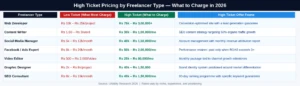
High ticket pricing benchmarks by freelancer type India 2026 | Source: UAbility Research
Why Beginners Think They Cannot Charge High Ticket
There are two reasons most beginners avoid high ticket pricing:
They believe they need more experience first which leads to taking low-paying work to gain experience, which attracts more low-paying clients, which never generates the results needed to justify premium rates.
They do not know how to communicate value in outcome terms so they default to listing what they do rather than what the client gets.
Both of these are solved the same way: pick a specific niche, build two to three documented results for clients in that niche, and present every conversation as an outcome discussion rather than a service pitch.
Step 1: Define Your Niche Before Approaching Any Client
This is the step most beginners skip and it is the reason most beginners do not get clients. Reaching out with a generic offering produces generic results. A clear niche makes every subsequent step the portfolio, the outreach, the pricing, the conversation dramatically more effective.
What a Good Freelance Niche Looks Like
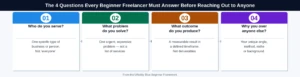
A good niche passes three tests: there is a specific type of person or business being served, there is a specific painful problem being solved, and there is a measurable outcome that results.
Type of Freelancer
Weak Niche (Too Broad)
Strong Niche (High Ticket Ready)
Web Developer
I build websites for businesses
I build lead-generation websites for independent physiotherapy clinics
Content Writer
I write content for brands
I write SEO blog content that ranks on Page 1 for SaaS companies in India
Social Media Manager
I manage Instagram for businesses
I grow Instagram accounts for fitness coaches from 0 to 10,000 followers in 90 days
Facebook Ads Expert
I run paid ads for eCommerce
I run ROAS-positive Facebook ad campaigns for D2C skincare brands
Video Editor
I edit YouTube videos
I edit long-form YouTube content for business coaches that drives channel monetisation
Graphic Designer
I design logos and branding
I build brand identities for premium service businesses entering competitive markets
The discomfort of narrowing the niche is the signal it is working. The tighter the niche, the less competition, the higher the justified price, and the easier the outreach.
Step 2: How to Get Your First Freelance Client With No Portfolio
Having no portfolio is not a disqualification from high ticket clients. It requires a different approach to credibility-building one that creates proof before the first paid client arrives.
There are four methods that work for beginners starting from zero:
Method 1: Create a sample piece at target quality. Build one piece of work a website, a content strategy, an ad campaign, a designed brief at the quality level that justifies premium pricing. For a web developer targeting physiotherapy clinics, this means building a sample clinic website with a lead generation focus. Most beginners never do this. Doing it creates an immediate advantage.
Method 2: Serve two to three people for documented proof. Offer help to two or three businesses in the target niche at reduced or no cost in exchange for a specific, written testimonial that names the problem, what was done, and what result occurred. A testimonial that says a website generated 8 new enquiries in the first 30 days is worth more than 20 generic five-star reviews.
Method 3: Offer a risk-reversal guarantee. Approach early clients with a results-based offer: pay after results are delivered, or a 14-day trial with full commitment only if the outcome is being delivered. This removes the primary objection for paying a beginner at premium rates.
Method 4: Document publicly. Create LinkedIn posts or short videos showing the thinking process how a landing page problem was diagnosed, what solution was designed and why, what the result was. This builds expertise perception before any client results exist.
Freelancers with portfolio websites earn 35% more than those without one (Colorlib, 2026). The portfolio is not optional but it does not need to contain paid client work to justify premium pricing.
Step 3: Where to Find Freelance Clients (That Pay Premium)
There are two categories of channels for finding freelance clients: platforms where clients come to the freelancer, and direct outreach where the freelancer goes to the client. For high ticket freelancing, the second category is significantly more effective at the early stage.
Direct Outreach: The Fastest Path to High Ticket Clients
Direct outreach means identifying specific businesses that match the ideal client profile and sending personalised messages that demonstrate genuine understanding of their situation. This is not cold spam it is research-backed, value-first communication.
The channels that work best for direct outreach in India in 2026:
Channel
Best For
What Works
Instagram DM
Coaches, fitness trainers, course creators
Comment genuinely on their content first. Message referencing a specific post or problem noticed.
LinkedIn
B2B consultants, agencies, SaaS companies
Connect, engage with their posts for one week, then message with a specific observation about their business.
WhatsApp (warm network)
Local businesses, referral leads
Direct, personal outreach. Most underused channel for beginners.
Cold Email
Website-based businesses, eCommerce brands
Research the business, identify a specific gap, lead with value not a pitch.
Facebook Groups
Coaches, online business owners
Provide genuine value in the group. DM those who engage with the posts.
Freelance Platforms: Where to Use Them and Where to Stop
Freelance platforms like Upwork, Fiverr, and Freelancer.com have a role but it is a limited one for anyone targeting high ticket clients. Platforms are useful for building the first one to three testimonials at a reduced rate. They are not suitable as a long-term client source because the platform controls pricing, the relationship, and the communication.
Platform
Best Use Case
High Ticket Friendly?
Limitation
Upwork
Getting first 2-3 clients with documented results
Partially for projects above $500
20% platform fee on first $500 per client
Fiverr
One-off creative work, logo design, quick projects
No optimised for low-ticket gigs
Flat-rate structure limits relationship depth
LinkedIn
Direct outreach and inbound positioning
Yes full control of pricing and relationship
Requires consistent content investment
Instagram DM
Coaches, creators, wellness businesses
Yes relationship-first channel
Works only with prior content presence
Direct website
Long-term inbound client source
Yes highest quality leads
Takes time to build organic authority
Referrals (42%) and personal networks (29%) remain the top sources of freelance clients globally (Colorlib, 2026). Platform clients represent a small fraction of what is available to a freelancer who builds direct relationships.
Step 4: How to Approach Clients for Freelance Work
Most beginner freelancers approach potential clients with some version of: I am a [skill] freelancer looking for projects. Do you need help? This message fails because it is about the sender, not the recipient, it offers nothing specific, and it asks the recipient to do all the thinking.
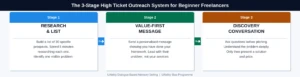
High ticket outreach flips this entirely:
UAbility Dialogue-Based Advisory Selling | From the UAbility Blue Programme
Stage 1: Research Before Reaching Out
Spend five minutes on each prospect before sending a single message. Look at their website, their social media, their content. Find one specific problem that is visible from the outside a landing page with no clear call to action, a social media feed with inconsistent branding, a YouTube channel that is clearly not optimised for search.
This research becomes the entire opening of the message.
Stage 2: The Value-First Opening Message
The message structure that consistently generates replies:
Message Element
What to Write
Example
Specific observation
One thing noticed about their business
Noticed the landing page for the gym membership offer has no CTA above the fold.
What it means for them
Why this is costing them something
This is likely causing most visitors to bounce before they see the pricing.
A small, free piece of value
Something that helps immediately
Put together a 3-point Loom on what would be changed. Want it?
This message is specific, personalised, leads with value, and asks for almost nothing. It demonstrates that research has been done. That is what gets replies.
Stage 3: The Discovery Conversation
When they reply, the instinct will be to immediately pitch. Resist this. Instead, ask questions that reveal the depth of their situation before presenting any solution or price.
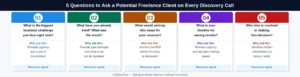
The 5 discovery questions from the UAbility Blue Dialogue-Based Advisory Selling Framework
These five questions serve a dual purpose. They help genuinely understand whether the client can be helped and how. They also help the client articulate their own problem in their own words which is what makes the price feel justified when it is eventually presented.
Freelance Questions to Ask a Client Before Starting Any Project
The questions asked before a project begins determine everything that happens after: the scope, the timeline, the price, and whether the client is satisfied at delivery. Most freelancers skip this stage entirely which is why scope creep, unpaid revisions, and dissatisfied clients are so common.
Question
Why It Matters
What the Answer Reveals
What does success look like to you in 90 days?
Defines the outcome upfront so delivery can be measured
Whether the client has realistic expectations
Who will be the primary contact for feedback and approvals?
Identifies decision-making structure
Whether there are hidden stakeholders who can derail the project
What has been tried before? What worked and what did not?
Prevents repeating failed approaches
How much education may be needed during delivery
What is the budget allocated for this?
Reveals whether high ticket pricing is viable
Whether to proceed or politely decline
What is the timeline for launch or completion?
Sets realistic expectations on both sides
Whether the timeline is workable or is a red flag
How will decisions be made by you alone or with others?
Identifies approval chain
How quickly feedback cycles will move
Clients who cannot answer these questions clearly are not ready to invest at premium rates. This is not a failure it is qualification working correctly. The discovery process should disqualify unready clients before a single deliverable is produced.
How to Get Clients by Freelancer Type
The principles are the same across every type of freelancing. The execution looks slightly different by category. Here is what works specifically for the most common freelancer types in India:
Web Developers
The portfolio mistake most web developer beginners make is building generic demo sites. Instead, build one sample website for a specific type of business a dentist, a fitness trainer, a real estate agent and make it genuinely excellent. Research that niche: what enquiries do they get, what do patients or clients typically ask, where does the website usually fail them.
Outreach angle: find businesses in that niche with outdated or low-converting websites. Identify one specific technical or conversion issue. Lead with that in the first message. Never send a generic list of services.
Guides
How to land high ticket clients as a web developer
Content writers are the most underpaid category in freelancing because most pitch words-per-rupee rather than outcomes. The shift: stop selling articles and start selling search visibility, lead generation, or audience growth within a specific industry vertical.
Outreach angle: find a business whose blog has zero organic traffic. Run their top pages through a free SEO tool. Identify one specific keyword opportunity they are missing. Lead with that finding. The message writes itself.
Facebook and Paid Ads Specialists
Ads specialists have the clearest ROI story of any freelance category and therefore the strongest case for high ticket pricing. A Rs 50,000 retainer that generates Rs 5,00,000 in revenue is not a cost; it is a 10x return.
The key for beginners: run one test campaign for a business in a specific niche at reduced cost. Document the ROAS. Use that as the core of every future pitch in that niche. One verified result in a niche is worth more than ten generic testimonials.
Social Media Managers
Social media management is often bought and sold as a commodity a fixed monthly rate for a fixed number of posts. The high ticket repositioning: sell follower growth, engagement rate improvement, or DM-to-booking conversion as the outcome, with a specific monthly target.
Outreach angle: find a coach or business with an Instagram page that has good content but poor engagement or a stagnant follower count. Analyse why posting schedule, hashtag strategy, CTA quality. Send three specific observations in the first message. This immediately demonstrates expertise before any proposal is made.
Graphic Designers
Graphic designers who sell logos sell at Rs 2,000 to Rs 8,000. Graphic designers who sell brand identity systems that position a business as the premium option in their market sell at Rs 40,000 to Rs 1,50,000.
The difference is framing. A logo is a deliverable. A brand identity system is a business tool. When the pitch connects the visual work to a business outcome client perception, competitive differentiation, pricing power the conversation about money changes entirely.
From First Client to High Ticket Freelance Business: What Comes Next
Landing the first client is the hardest step not because it requires more skill, but because it requires a mindset shift about what is being sold and who it is being sold to. Once that shift happens and the first high ticket result is documented, everything that follows becomes significantly easier.
The next steps after the first client are: systematise the outreach, build a consistent discovery call framework, create one piece of documented proof from the first engagement, and begin building inbound channels alongside outbound.
For freelancers who want to move through this faster with a structured system, accountability, and the same methodology that has produced results for 1,400+ coaches, consultants, and freelancers in India:
Build Your High Ticket Freelance Business With UAbility Blue
UAbility Blue covers niche selection, high ticket positioning, outreach systems, the full discovery call framework, and delivery the complete system from zero clients to a scalable freelance business. 4% acceptance rate. Apply to find out if it is a fit.
How to get clients for freelancing as a complete beginner?
Start by defining a specific niche one type of business, one problem you solve, one measurable outcome you deliver. Build one sample piece of work at high quality. Identify 30 specific prospects in that niche. Send personalised, value-first messages that reference something specific about each business. Ask to have a discovery conversation before pitching anything. This approach produces better results faster than any platform-based method, even with zero prior clients.
How to find clients for freelance work without using Upwork or Fiverr?
The most effective channels outside platforms are direct Instagram DM outreach, LinkedIn connection and outreach, WhatsApp warm network messaging, cold email to businesses in a specific niche, and Facebook groups where the target clients are active. The key in every channel is a personalised, research-backed message that leads with a specific observation about their business not a generic service pitch.
How to get your first freelance client with no experience?
Build one excellent sample piece of work in the target niche. Offer to work with two to three businesses at reduced or no cost in exchange for a documented testimonial with specific results. Use a risk-reversal offer: results-based payment or a free trial period. These three steps create enough credibility to approach high ticket clients without prior paid experience.
Where to find freelance clients in India?
The highest-quality freelance clients in India are found through direct outreach on Instagram, LinkedIn, and WhatsApp; through warm network referrals (which convert at approximately 26% according to Landbase, 2026); and through niche Facebook groups where the target audience is active. Freelance platforms like Upwork are useful for the first one to three testimonials but become a ceiling rather than a growth channel at the high ticket level.
What questions should I ask a client before starting freelance work?
The six most important questions are: What does success look like in 90 days? Who will be the primary contact for feedback and approvals? What has been tried before and what happened? What is the budget allocated for this project? What is the timeline for completion? Who else is involved in making decisions? These questions define scope, reveal readiness, and surface any hidden stakeholders before a project begins.
How to approach clients for freelance work without sounding desperate?
Lead with a specific observation about their business rather than a request for work. Reference something concrete a page on their website, a specific post, a gap in their content and offer one genuinely useful insight about it. Ask if they would find it useful to have a quick conversation about it. This framing positions the freelancer as an expert who noticed an opportunity, not a job seeker looking for any available work.
How much should a beginner freelancer charge?
A beginner should charge based on the outcome delivered, not on their level of experience. A beginner web developer who can demonstrate that their website generates 10 enquiries per week for a specific type of business can justify Rs 75,000 or more for that project. The price reflects the outcome, not the experience. Starting at low rates to build experience creates a credibility trap low-paying clients do not refer high-paying ones.
Is India a good market for high ticket freelancing?
Yes. India's freelance market is growing at 25.1% CAGR (Grand View Research, 2026), the average income for Indian freelancers is Rs 20 lakh per annum with 23% earning above Rs 40 lakh (Razorpay, 2026), and over 60% of cross-border freelance projects originate from the US, UK, and EU markets where high ticket pricing is already the norm. The opportunity is significant, and the competition at the premium end is far lower than at the low-ticket commodity end.
Subscribe to our newsletter!
Browse Similar Blogs
How to Make ₹1 Lakh Per Month Without Working More Hours
Rs 1 lakh per month. That is the number most Indians think about when they want to escape financial stress...