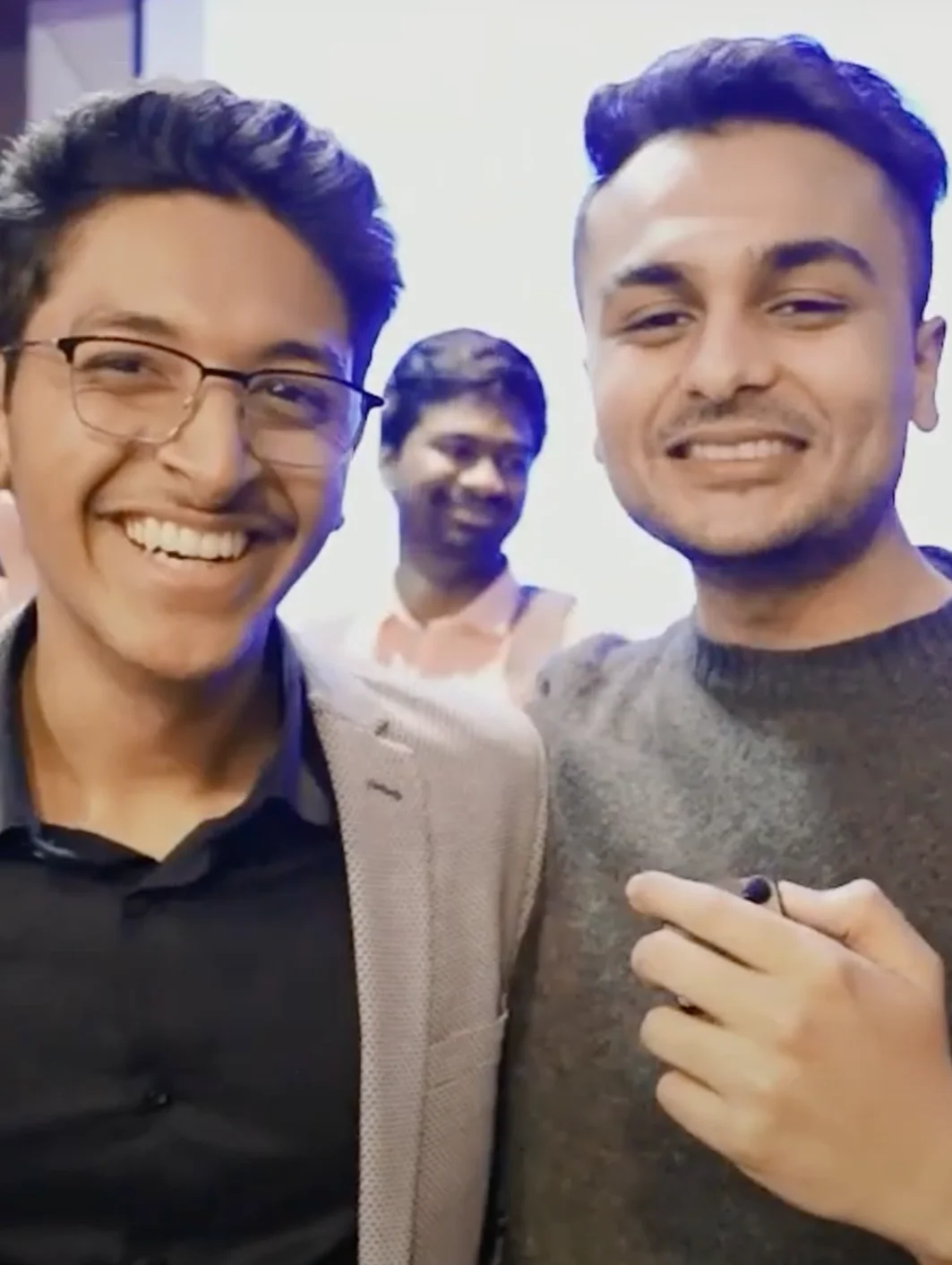
Since joining UAbility, I implemented the VSL funnel and the SLOSHED Framework, which helped me close 19 sales and generate ₹8.3 Lakhs in revenue. My AOV jumped from ₹24K to ₹50K, and I even achieved 22.58X & 36.8X ROAS. The experience has been amazing — got clarity, confidence, and consistent results!
Since joining UAbility, I implemented the VSL funnel and the SLOSHED Framework, which helped me close 19 sales and generate ₹8.3 Lakhs in revenue. My AOV jumped from ₹24K to ₹50K, and I even achieved 22.58X & 36.8X ROAS. The experience has been amazing — got clarity, confidence, and consistent results!
Struggling to get web development clients? Here is the exact niche, offer, and outreach system that took Nirmit from Rs 36,000/month to $100,000+ in sales.
Three web developers Akshat, Abhinav, and Nirmit were earning Rs 35,000 to Rs 50,000 per month building websites. They were technically capable. They had portfolios. They were doing everything that freelancing guides recommend.
They were still struggling to find clients consistently, had no predictable lead generation system, and no clear niche. The income ceiling felt impossible to break.
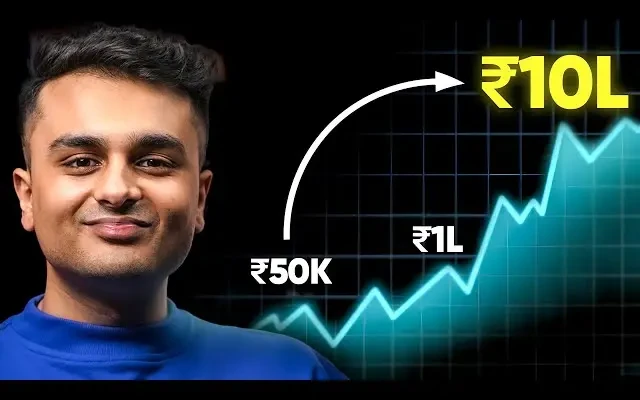
Within months of applying one framework, they went from Rs 40,000 per month to $5,500 per month, then $14,000 per month, then $25,000 per month. Nirmit crossed $100,000 in total sales roughly Rs 84 lakhs.
The change was not a new skill, a new technology, or a new platform. It was a fundamentally different answer to one question: what are you actually selling?
Web Developer Salary in India: Why the Job Route Has a Ceiling
Before covering how to get clients, it is worth understanding what the alternative a job actually looks like in 2026. These are verified numbers from PayScale, Indeed, and AmbitionBox:
Experience Level
Monthly Salary (Job)
Annual CTC
Time to Reach This
Fresher (0-1 year)
Rs 20,000 – Rs 33,000
Rs 2.5 – 4 LPA
0 months
Junior (1-3 years)
Rs 33,000 – Rs 50,000
Rs 4 – 6 LPA
12 – 36 months
Mid-level (3-5 years)
Rs 50,000 – Rs 90,000
Rs 6 – 10.8 LPA
36 – 60 months
Senior (5-8 years)
Rs 83,000 – Rs 1,25,000
Rs 10 – 15 LPA
60 – 96 months
Lead / Architect (8+ years)
Rs 1,25,000 – Rs 2,00,000+
Rs 15 – 24+ LPA
96+ months
The average web developer salary in India is Rs 4,12,400 per year Rs 34,366 per month (PayScale, 2026). Reaching Rs 1 lakh per month through a job requires 5 to 8 years of experience and the right company. Nirmit was already earning Rs 36,845 per month as a freelancer and crossed Rs 74 lakhs in revenue in 10 months by changing what he sold, not the technical work he did.
Why Upwork and Fiverr Are Not a Long-Term Strategy
Most web developers start on Upwork or Fiverr because the advice everywhere is to build reviews and raise rates over time. This approach has three structural problems that make long-term growth nearly impossible:
The Platform Problem
The Real Cost
Long-Term Impact
Fiverr takes 20% commission on every payment
Rs 20,000 lost from every Rs 1L earned
Forces lower rates to stay competitive margin never improves
Upwork charges a flat 10% fee in 2026
Rs 10,000 lost from every Rs 1L earned
Compounds into lakhs lost over a career
18M+ freelancers compete on Upwork globally
Hundreds bid on the same project
Price becomes the only differentiator race to the bottom
Zero ownership of the client relationship
Account can be suspended or delisted anytime
One policy change removes the entire income source
Algorithm controls visibility
Ranking changes with every platform update
Revenue becomes unpredictable and volatile
Platforms serve exactly one purpose well: building the first two to three testimonials. Every hour spent bidding on Upwork after that is time not spent building a direct client system that compounds.
The Real Reason Web Developers Cannot Get High Ticket Clients
This is what no one tells beginners: the client acquisition problem is almost never about the portfolio, the platform, or the pricing. It is about what is being sold.
When the pitch is ‘I build websites,’ the client compares on price, portfolio, and years of experience. This is a race that no one wins, because there is always someone cheaper. When the pitch is ‘I help personal trainers get more clients,’ the conversation changes entirely. The client is no longer asking how much a website costs. They are asking whether this person can actually solve their business problem.
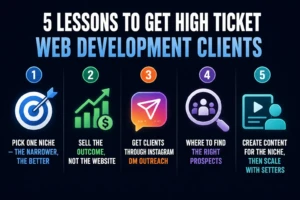
Lesson 1: Pick One Niche- The Narrower, The Better
The biggest mistake web developers make is trying to serve everyone. Restaurants, doctors, coaches, gyms, real estate the wider the target, the weaker the positioning. Akshat, Abhinav, and Nirmit made one specific choice:
Niche: Personal trainers | Geography: Dubai
That is it. Not fitness businesses. Not wellness brands. Not gyms. Personal trainers in one specific city. This narrowness is what made everything else easier the outreach message, the sample website, the case studies, and the pricing.
The logic behind choosing this niche: personal trainers need websites, the market was understood, and Dubai businesses generally have higher purchasing power than equivalent Indian markets. Three criteria. Simple decision.
Generic Positioning (Avoid)
Niche Positioning (Use This)
Why It Works
I build websites for businesses
I build client acquisition systems for personal trainers
Removes all price comparison — no one else says this
I do web design and development
I help physiotherapy clinics fill their appointment calendar
Client immediately knows you understand their world
I build eCommerce stores
I build Shopify stores for D2C skincare brands targeting 3x ROAS
Makes the ROI conversation natural before pricing
I am a full-stack developer
I build lead generation websites for independent CAs in metros
Specificity signals expertise commands premium
The discomfort of narrowing down is the signal that it is working. Generalists compete on price. Specialists are sought out and paid premiums.
Lesson 2: Sell the Outcome, Not the Website
This is the most important concept in the entire framework. Personal trainers do not want a website. They want more leads, more sales calls, more clients, and more revenue. The website is one tool in that system not the thing being bought.
When Akshat, Abhinav, and Nirmit made this shift, the offer changed from:
“Website Design I will build you a 5-page website.”
To:
“Done-For-You Client Acquisition System website, lead generation, appointment booking, and a marketing framework that brings in clients consistently.”
The deliverable was still largely a website. But what was being sold was a business result. That shift justified $5,000+ packages where the same technical work previously commanded $200 to $500.
Makes the investment compound beyond the website launch
This is what high ticket sales means in the context of web development: selling a transformation, not a transaction. The client is not buying Rs 1,50,000 worth of code. They are buying a system that generates Rs 30,000 to Rs 1,00,000 per month in additional revenue. That ROI makes the price obvious.
Lesson 3: How to Get Freelance Clients Through Instagram DM Outreach
Akshat, Abhinav, and Nirmit did not wait for referrals. They did not post content endlessly and hope for inbound. They did not run paid ads. They went directly to where their niche audience was and started conversations. The channel was Instagram. The method was personalised DM outreach.
The 5-Step DM Framework- Word for Word
Here is the exact structure used in the outreach that generated the results:
Step 1 — Find Common Ground: “Hey John, I noticed we follow the same fitness page.”
This makes the message feel personal and relevant rather than cold. It is not a fabricated opener — it requires actual research. Follow the prospect, look at what they engage with, find a genuine connection point.
Step 2 — Build Rapport: “Wanted to connect with a fellow fitness enthusiast.”
Human connection before business. This is not manipulation — it is the natural sequence of how trust is built. Business comes after relationship, not instead of it.
Clear, specific, niche-focused. Not ‘I am a web designer.’ Not ‘I do digital marketing.’ One sentence that tells them exactly who is served and what outcome is delivered.
Step 4 — Mention the Pain Point: “Without worrying about where their next client is coming from.”
This is the most important line. It speaks to the fear that every personal trainer has — unpredictable income, inconsistent clients, no system. When a prospect reads this, they feel understood. That feeling is what opens the conversation.
Step 5 — Ask One Question: “Is that something you’re interested in?”
Not a pitch. Not a portfolio link. Not a Calendly. One question that starts a conversation. The prospect can say yes or no without feeling pressured. Most say yes because the message was specific to their situation.
The goal of the first DM is never to close a client. It is to start a conversation. The sale happens inside the conversation after the problem is understood and the outcome is connected to what they want.
Lesson 4: Where to Find the Right Prospects
The prospecting method used was direct and specific. Two approaches:
Method 1: Niche Community Followers
Find Instagram pages that serve the target niche — fitness communities, gym owner groups, personal trainer education pages. Open the followers list. Follow the prospects who fit the ideal client profile. Wait for them to follow back. Then send the DM.
The reason for waiting for a follow-back: messages from non-followers on Instagram go into a hidden inbox that most people never check. A mutual follow means the message lands in the primary inbox.
Method 2: Influencer Audience Targeting
Find the influencers and educators that the target clients follow fitness business coaches, gym business consultants, entrepreneurship accounts for trainers. Engage with their content genuinely. Then reach out to the audience members who engage with those influencers.
The logic: someone who follows a fitness business educator is already interested in growing their fitness business. They are a pre-warmed prospect before a single message is sent.
Prospecting Channel
Best For
How to Execute
Instagram follower lists
Fitness trainers, coaches, wellness businesses
Find 3-5 niche pages. Work through their followers. Follow 20-30 per day. DM those who follow back.
LinkedIn connections
B2B service businesses, consultants, agencies
Connect with decision-makers. Engage with their content for 1 week. Then message.
Google Maps search
Local clinics, salons, CAs, legal firms
Search niche + city. Find businesses with outdated or missing websites. Reach out by email or WhatsApp.
Provide value in groups first. DM those who engage with the posts.
Cold email
eCommerce brands, SaaS companies, D2C businesses
Research the company, find one specific website gap, lead with that in the subject line.
Lesson 5: Create Content for the Niche, Then Scale With Setters
Alongside outbound outreach, the framework recommends posting content that the target audience cares about not generic web design tips, but business growth content for the specific niche.
For a web developer serving personal trainers, this means posts about client acquisition for fitness professionals, Instagram growth for trainers, how to generate more leads as a personal trainer. Not ‘here is a website we built.’ Not ‘top 5 web design trends.’ Content that makes the developer look like the go-to growth expert for that niche.
Scaling With Setters
Once the outreach system is working consistently meaning conversations are being booked regularly and clients are being closed the next step is hiring a setter. A setter’s job is to handle the DM conversations, qualify prospects, and book discovery calls. The founder then focuses only on the sales call and delivery.
The recommendation is to start with interns or junior team members who are trained on the exact DM framework. This is how the system becomes non-linear outreach runs without the founder doing it personally.
This is the transition from freelancer to agency. The niche, the offer, and the outreach system stay the same. A team is built around executing it, which is what allows revenue to compound past the point where one person can handle everything alone.
What to Charge: High Ticket Pricing for Web Developers
Once the offer is positioned around a business outcome rather than a deliverable, the pricing conversation changes completely. Here is how to think about it:
Offer Type
What Is Included
Price Range (India 2026)
ROI Justification
Niche-specific lead gen website
Conversion-optimised site for one type of business
Rs 75,000 – Rs 1,50,000
3-month payback on first 2-3 new clients for the business
Client acquisition system
Website + booking + lead gen framework
Rs 1,50,000 – Rs 3,00,000
Pays back in month one for most service businesses
eCommerce / Shopify store
Revenue-generating store with product strategy
Rs 1,50,000 – Rs 5,00,000
Direct revenue attribution easy to justify
Ongoing growth retainer
Monthly updates, SEO, performance reporting
Rs 25,000 – Rs 60,000/month
Recurring income that compounds with each renewal
Full funnel system
Website + VSL + email sequence + booking
Rs 2,00,000 – Rs 10,00,000
Highest ticket requires a verified niche track record
The retainer model is the most important for long-term income stability. A website built once generates a single payment. A website maintained and grown over 12 months generates Rs 3,00,000 to Rs 7,20,000 in recurring revenue from one client. Three retainer clients at Rs 30,000 per month equals Rs 90,000 per month before any new project is sold.
work with uability
High Ticket Lead Generation for Web Development Freelancers
The 30-Day Plan: From Zero to First Web Development Client
Week
Focus
Exact Actions
Week 1
Niche and Offer
Choose one niche. Write the outcome-based positioning statement. Build one excellent sample website for a fictional business in that niche at the quality level that justifies the target price.
Week 2
Prospect Research
Identify 30 specific businesses or individuals in the niche on Instagram or LinkedIn. Follow them. Research each one for 5 minutes. Note one specific visible problem with their online presence.
Week 3
Outreach
Send 10 personalised DMs per day using the 5-step framework. Wait for follow-backs before messaging. Follow up with anyone who replies. Target 5 to 10 discovery conversations booked.
Week 4
Close
Run structured discovery conversations. Ask about their business before presenting any offer. Present the outcome-based package anchored to their stated goals. Close the first high ticket client.
The formula that worked for Akshat, Abhinav, and Nirmit is repeatable: Niche + Outcome + Outreach. Pick one type of client, understand their real problem, package the website as a solution to that problem, and go directly to where they are. Everything else content, setters, paid ads comes after the system is proven.
How UAbility Blue Helps Web Developers Build This System
UAbility Blue is the programme that coached Nirmit, Akshat, Abhinav, and 1,600+ others through exactly this process niche selection, outcome-based offer design, the outreach framework, the discovery call structure, and the delivery system that generates testimonials for the next client.
The programme covers everything from the first DM to the first Rs 1 lakh month and beyond including how to scale to Rs 3 lakhs per month with setters, retainer clients, and an inbound funnel.
How to get clients for web development as a beginner in India?
The fastest method is to choose one specific niche one type of business with a clear, expensive problem build one excellent sample website for that niche, and send personalised, value-first messages on Instagram or LinkedIn to 30 specific prospects. Use the 5-step DM framework: find common ground, build rapport, introduce expertise, mention the pain point, and ask one question. This generates replies and conversations without a platform fee or a bidding war.
Is Upwork good for web developers in India?
Upwork is useful for getting the first two to three testimonials. As a long-term business strategy, it has structural problems: a 10% flat fee on all earnings, competition from 18M+ registered freelancers globally, algorithm-dependent visibility, and zero ownership of the client relationship. Web developers who build a direct outreach system consistently outperform platform-dependent developers at the Rs 1 lakh per month level and above.
What is the web developer salary in India in 2026?
The average web developer salary in India is Rs 4,12,400 per year roughly Rs 34,366 per month (PayScale, 2026). Freshers earn Rs 20,000 to Rs 33,000 per month. Mid-level developers with 3 to 5 years earn Rs 50,000 to Rs 90,000 per month. Senior developers with 8 or more years earn Rs 1,25,000 to Rs 2,00,000 per month. A high ticket freelance web developer can earn a senior developer's annual salary in a single project.
What does high ticket sales mean for web developers?
High ticket sales for web developers means selling a defined business outcome rather than a website deliverable. A Rs 15,000 website is a low ticket transaction. A Rs 1,50,000 client acquisition system for a physiotherapy clinic including a conversion-optimised website, lead generation, and appointment booking is a high ticket sale. The technical work is similar. The offer, the positioning, and the buyer are completely different.
How do you get high ticket clients as a web developer?
Pick one niche. Build an outcome-based offer for that niche. Find prospects on Instagram by engaging with niche community followers. Send personalised DMs using the 5-step framework: common ground, rapport, expertise, pain point, one question. Run a structured discovery conversation that asks about their business before presenting any solution. Price based on the business outcome delivered. This is the exact system Nirmit used to cross $100,000 in total sales.
What is the best niche for web development in India?
The best niche is one where the client has a measurable, expensive problem that a website directly solves, the client has the budget to pay premium prices, and there are enough of them to build a sustainable client base. Practical examples: physiotherapy clinics, independent CAs, interior designers, coaching businesses, D2C eCommerce brands, and dental clinics. Akshat, Abhinav, and Nirmit chose personal trainers in Dubai. The exact niche matters less than the specificity of the choice.
How long does it take to get the first web development client?
With consistent outbound outreach 10 personalised DMs per day to the right niche most web developers book their first discovery conversation within 7 to 14 days and close their first client within 30 to 45 days. Nirmit went from Rs 36,845 per month to Rs 74 lakhs in total revenue in 10 months. The timeline depends on how quickly the outreach starts and how specifically the niche is defined.
Should I post content on Instagram to get web development clients?
Content helps, but it is not the fastest starting point. Outbound outreach direct DMs produces results in weeks. Content takes months to build an audience. The recommendation is to do both simultaneously: post niche-specific content about business growth for the target client type, and run direct outreach at the same time. Content warms up prospects who receive the DMs; the DMs produce immediate conversations rather than waiting for the content to compound.
Subscribe to our newsletter!
Browse Similar Blogs
How to Get Clients for Your Digital Marketing Agency: 7 Methods That Actually Work
Would you take fitness advice from a personal trainer who is obese? Would you take financial advice from an accountant...