Most pitches fail before the call even reaches the offer. The agency leads with its services, works through everything it does, and only gets to the client’s actual problem in the last two minutes, if at all. By then the prospect has stopped listening, because nothing said so far has proven you understand their situation.
Why the 1:1 Call Still Wins the Deal
A landing page or a deck can generate interest, but it can’t do what a live call does. Every prospect’s situation is genuinely different, and a call is the only place you can uncover their specific pain, goals, and obstacles in real time and shape the pitch around exactly that, instead of a version of the pitch that’s roughly right for everyone. People also buy on emotion and justify with logic afterward, and a call reaches the layer underneath the surface-level problem in a way a sales page simply can’t.
There’s a more practical reason too. Through SLOSHED, most objections get handled systematically during the call itself, well before the price is ever revealed, so by the time you get there the prospect has already worked through their own hesitations out loud. That’s also where real trust gets built, not through rapport tricks, but by demonstrating you understand the problem at a level no one else bothered to reach. High-ticket prospects don’t want to be sold to. They want to be guided to a decision they were already circling.
The Pitch Doesn’t Start on the Call
A pitch call sits inside a two-part pipeline, and if the first half is broken, no script fixes the second half. The Pre-Sales Process covers everything before the prospect gets on the closing call: a setter or discovery call that qualifies fit and books the meeting, and pre-call nurture (reminders, case studies, short content) that reduces no-shows and gets the prospect emotionally invested before they’ve even spoken to you. The Sales Process is where SLOSHED actually runs, and it only works as well as the prospect arriving already problem-aware.
The SLOSHED Framework
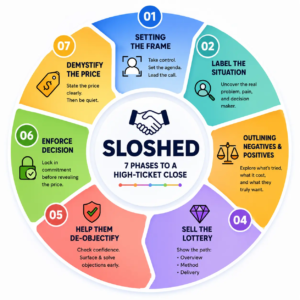
SLOSHED is the structure for the pitch and close itself. Each phase builds directly on the one before it, and skipping a phase is usually why objections surface later than they should, right when you least want them to.
|
Letter
|
Phase
|
What Happens
|
|
S
|
Setting the Frame
|
Take leadership of the call and agree on how it will proceed. Without this, the prospect controls the call and you lose the sale.
|
|
L
|
Label the Situation
|
Isolate their challenges, extract the real pain, inject doubt about solving it alone, and identify who holds decision authority.
|
|
O
|
Outlining Negatives & Positives
|
Surface what they’ve already tried, what it’s cost them, and what they actually want instead.
|
|
S
|
Sell the Lottery
|
Pitch in three parts: Eagle’s Eye View (overview), The Boat (your method), and Delivery (how results happen). This should feel like conversation, not a presentation.
|
|
H
|
Help Them De-objectify
|
Take a temperature check and surface hidden objections before they can derail the close.
|
|
E
|
Enforce Decision
|
Lock in commitment to move forward before the price is revealed.
|
|
D
|
Demystify the Price
|
Reveal the investment simply and confidently, then stop talking.
|
What This Actually Sounds Like on an Agency Pitch
Outlining Negatives and Positives is where you ask what they’ve already tried and what it’s cost them, then what they actually want instead. This step is easy to rush past, but it’s what builds the emotional weight that makes the eventual price feel small by comparison. Sell the Lottery is the actual pitch, delivered in three parts: a high-level overview of the path forward, an explanation of your specific method, and a plain description of how delivery actually works. Done well, this doesn’t feel like a pitch at all, it feels like the natural next thing to say after everything the prospect just told you.
Help Them De-objectify is a simple temperature check, something like asking on a scale of one to ten how confident they feel this solves it, which surfaces hesitation while there’s still room to work with it. Enforce Decision locks in a commitment to move forward before any number is on the table. And Demystify the Price is exactly what it sounds like: state the number plainly, then stop talking. Whoever speaks first after the price is revealed usually loses leverage.
Handling Objections When They Do Come Up
Most objections in SLOSHED are pre-handled through the checkpoints before the price reveal, but when one does surface, the order matters more than the wording. Pace the objection first, acknowledge it without getting defensive. Then tie down certainty on the process itself, separate from whatever they’re objecting to. From there, isolate the real objection underneath, is it a “should I do this” concern or a “how would I actually do this” concern, because those need completely different responses. Only then do you resolve it, using whichever approach actually fits that specific objection rather than a generic rebuttal.
Mistakes That Quietly Kill Pitches
A handful of habits account for most lost deals, and none of them are about the words being used.
- Letting one bad call bleed into the next – reset between calls, or the energy from a lost deal carries into the next prospect’s ear.
- Being attached to the outcome – the moment you need the sale, your tonality shifts upward and you rush through checkpoints.
- Upward tonality – every question should land downward or neutral. You are the doctor, not the patient.
- Not staying silent after a question – wait a few seconds after they finish. The gold is usually in the second half of the answer.
- Coaching the prospect during discovery – fixing their problem mid-call kills buying tension. Save solutions for Sell the Lottery.
Try This on Your Next Pitch
Before your next call, write down which phase you tend to skip. Most reps jump straight from Label the Situation to Sell the Lottery, skipping Outlining Negatives and Positives entirely, which is exactly where the emotional weight of the decision gets built. Run the full sequence once, in order, and notice how differently the price lands when nothing’s been skipped.
Pitching well only works if it’s sitting on top of the right foundation, and that starts before the call ever happens. If your niche or offer is vague, no amount of SLOSHED technique will save the pitch, because you’ll be diagnosing a problem you never clearly defined in the first place. That’s really a business model canvas problem more than a sales problem, and it’s usually the actual reason a pitch that sounds fine on paper keeps stalling out on calls.
This is the kind of thing Rohan Dhawan, high ticket business coach, works through with agency owners directly, niche, offer, and the full sales process built as one connected system rather than a script you bolt onto a broken pitch. If you’re just getting this foundation in place, UAbility Blue is the entry point into that system, covering SLOSHED in full alongside the offer and acquisition work that has to come before it. And if the real issue is that you’re not even getting enough pitch calls booked in the first place, that’s worth fixing before the script, which is where how agencies get clients consistently is the better place to start.
.
FAQs
How do you start a pitch to a client?
You start by framing the call, not by introducing your company: stating how the conversation will go before asking anything. This is the Setting the Frame phase of SLOSHED, and it keeps you in control of the call structure from the first minute rather than the prospect.
What should you say when pitching to a client on a call?
Lead with questions about their current situation before mentioning your services, then pitch only after their problem and its cost have been clearly established. A pitch delivered before the problem is confirmed is a solution to a problem you haven't verified exists
How long should a client pitch be?
Most high-ticket pitch calls run 30 to 60 minutes, with the majority of that time spent on diagnosis rather than presentation. Length should be driven by how long proper diagnosis takes, not by a fixed script.
How do you pitch a client through email?
Reference something specific about their business, state the problem in one line, and ask for a short call rather than attempting to close in the email itself. Email works as a bridge to the live call, not a replacement for it, since high-ticket decisions rarely close without one.
How do you pitch your company to a client?
Lead with the client's problem, then introduce your company only in relation to solving that specific problem, not as a standalone overview. A generic company introduction at the start of a pitch is the most common point where prospects disengage.
What's the difference between pitching a product and pitching a service to a client?
A product pitch centers on features and a demo; a high-ticket service pitch centers on outcomes and delivery, since the client is buying a result they can't evaluate in advance. This is why SLOSHED allocates most of the call to diagnosis before any pitching happens.